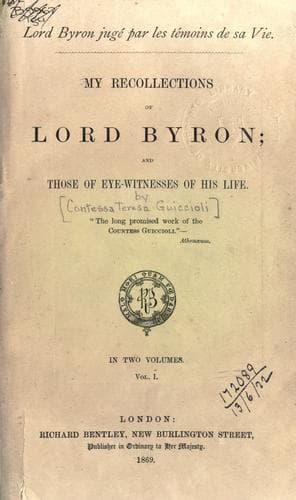
My Recollections of Lord ByronGuiccioli, Teresa, contessa di
General
My Recollections of Lord Byron
Guiccioli, Teresa, contessa di
Byron, George Gordon Byron, Baron, 1788-1824; Poets, English -- 19th century -- Biography
Byron's death plunged Kennedy into the deepest grief; and it was then
that he gathered all his conversations which he had had with Lord Byron
into one volume, which he published. But his friends, or so-called
friends, showed themselves hostile to the publication. Some feared that
he would exaggerate either Lord Byron's faith or want of it, and others,
less disinterested, apprehended the revelation of some of their own
views, which might fail to meet with the approval of the public at home.
When, therefore, Kennedy applied to several of these who were at
Missolonghi to know in what religious frame of mind Byron died, he met
with rebukes of all kinds, and his credit was attacked by articles in
newspapers, endeavoring to show that Byron had all along been laughing
at the doctor. All these attacks might have influenced Kennedy's picture
of Byron, but it will be seen that, with the exception of a few
puritanical touches, the artist's picture is not unworthy of the
original.
In the preface to his book, the doctor, not knowing whether he should
make use of the conversation he had had with Byron to give a greater
interest to his work, the object of which was to be of use to the
public, answers his own objections in the following words:--
"If my doing so would injure his character or fame, there could not be a
moment's hesitation in deciding on the baseness of the measure. But, as
far as I can judge, a true statement of what occurred will place his
lordship's character in a fairer light than he has himself done in many
of his writings, or than can, perhaps, be done by a friendly biographer.
The brightest parts of his life were those which he spent in Cephalonia
and Missolonghi, and the fact of his wishing to hear Christianity
explained by one, simply because he believed him to be sincere,
confessing that he derived no happiness from his unsettled notions on
religion, expressing a desire to be convinced, and his carrying with
him religious books, and promising to give the subject a more attentive
study than he had ever done, will throw a certain lustre over the darker
side of his fame, ... and deprive deists of the right of quoting him as
a cool, deliberate rejecter of Christianity."
To these very significant declarations, coming as they do from so
conscientious a believer as Kennedy, I shall add the testimony of a few
persons who have been conspicuous by their hostility to Byron. Mr. Galt
is one of these, and yet he says:--
"I am persuaded, nevertheless, that to class him among absolute infidels
were to do injustice to his memory, and that he has suffered
uncharitably in the opinion of the 'rigidly righteous,' who, because he
had not attached himself to any particular sect or congregation, assumed
that he was an adversary to religion. To claim for him any credit as a
pious man would be absurd; but, to suppose he had not as deep an
interest as other men 'in his soul's health and welfare,' was to impute
to him a nature which can not exist."
Public-domain text, read in full here on John Shaqi.
Reviews
Reviews
No reviews yet
Be the first to share your thoughts on this work.
Elsewhere in the archive
Join the Discussion
Join the discussion
Sign in to leave a comment or review.
Sign InorCreate an account