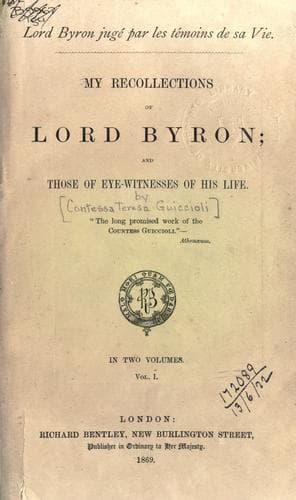
My Recollections of Lord ByronGuiccioli, Teresa, contessa di
General
My Recollections of Lord Byron
Guiccioli, Teresa, contessa di
Byron, George Gordon Byron, Baron, 1788-1824; Poets, English -- 19th century -- Biography
And elsewhere, after showing, first, what Byron did not believe in;
secondly, what he would have liked to believe, but which had not
sufficient grounds to satisfy his reason; thirdly, what he did actually
believe, Mr. Galt adds:--
"Whatever was the degree of Lord Byron's dubiety as to points of faith
and doctrine, he could not be accused of gross ignorance, nor described
as animated by any hostile feeling against religion."
The same biographer says elsewhere:--
"That Byron was deeply imbued with the essence of natural piety; that he
often felt the power and being of a God thrilling in all his frame, and
glowing in his bosom, I declare my thorough persuasion; and that he
believed in some of the tenets and in the philosophy of Christianity, as
they influence the spirit and conduct of men, I am as little disposed to
doubt; especially if those portions of his works which only trench upon
the subject, and which bear the impression of fervor and earnestness,
may be admitted as evidence. But he was not a member of any particular
church."
Medwin, who might be considered to be an authority, before his vanity
was wounded by the publication of writings wherein his good faith was
questioned, and it was shown that Lord Byron had no great esteem for his
talents, says,--
"It is difficult to judge, from the contradictory nature of his
writings, what the religious opinions of Lord Byron were. But on the
whole, if he were occasionally skeptical, yet his wavering never
amounted to a disbelief in the divine Founder of Christianity. 'I always
took great delight,' observed he, 'in the English Cathedral service. It
can not fail to inspire every man who feels at all, with devotion.
Notwithstanding which, Christianity is not the best source of
inspiration for a poet. No poet should be tied down to a direct
profession of faith. Metaphysics open a vast field. Nature and
heterodoxy present to the poet's imagination fertile sources from which
Christianity forbids him to draw;' and he exemplified his meaning by a
review of the works of Tasso and Milton.
"'Here is a little book somebody has sent me about Christianity," he
said to Shelley and me, 'that has made me very uncomfortable. The
reasoning seems to me very strong, the proofs are very staggering. I
don't think you can answer it, Shelley; at least, I am sure I can't,
and, what is more, I don't wish to do so.'"
Speaking of Gibbon, he says,--"L---- B---- thought the question set at
rest in the 'History of the Decline and Fall,' but I am not so easily
convinced. It is not a matter of volition to unbelieve. Who likes to own
that he has been a fool all his life,--to unlearn all that he has been
taught in his youth? Or can think that some of the best men that ever
lived have been fools?" And again,--
Public-domain text, read in full here on John Shaqi.
Reviews
Reviews
No reviews yet
Be the first to share your thoughts on this work.
Elsewhere in the archive
Join the Discussion
Join the discussion
Sign in to leave a comment or review.
Sign InorCreate an account