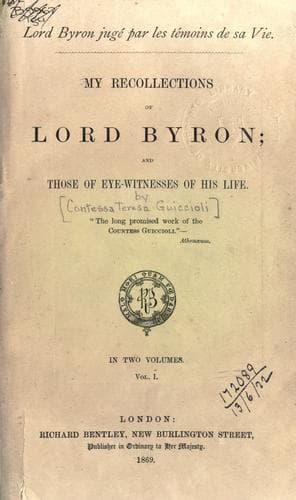
My Recollections of Lord ByronGuiccioli, Teresa, contessa di
General
My Recollections of Lord Byron
Guiccioli, Teresa, contessa di
Byron, George Gordon Byron, Baron, 1788-1824; Poets, English -- 19th century -- Biography
"You believe in Plato's three principles, why not in the Trinity? One is
not more mystical than the other. I don't know why I am considered an
enemy to religion, and an unbeliever. I disowned the other day that I
was of Shelley's school in metaphysics, though I admired his poetry."
"Although," says Lord Harrington, "Byron was no Christian, he was a firm
believer in the existence of a God. It is, therefore, equally remote
from truth to represent him as either an atheist or a Christian. He was,
as he has often told me, a confirmed Deist." Further on, the same
writer adds:--
"Byron always maintained that he was a skeptic, but he was not so at
all. During a ride at Cephalonia, which lasted two or three hours almost
without a pause, he began to talk about 'Cain' and his religious
opinions, and he condemned all atheists, and maintained the principles
of Deism." Mr. Finlay, who used to see Lord Byron in Greece, says, in a
letter to his friend Lord Harrington:--
"Lord Byron liked exceedingly to converse upon religious topics, but I
never once heard him openly profess to be a Deist."
These quotations are sufficiently numerous, and all point to the same
conclusion, but I must quote the words of Gamba before I conclude this
subject. He was, as it is known, the great friend of Byron, and alas!
sacrificed his noble self, at the age of twenty-four, to the cause of
Greece. To Kennedy's inquiries respecting Lord Byron's religious
tendencies at Missolonghi, P. Gamba replied as follows:--
"My belief is that his religious opinions were not fixed. I mean, that
he was not more inclined toward one than toward another of the Christian
sects; but that his feelings were thoroughly religious, and that he
entertained the highest respect for the doctrines of Christ, which he
considered to be the source of virtue and of goodness. As for the
incomprehensible mysteries of religion, his mind floated in doubts which
he wished most earnestly to dispel, as they oppressed him, and that is
why he never avoided a conversation on the subject, as you are well
aware.
Public-domain text, read in full here on John Shaqi.
Reviews
Reviews
No reviews yet
Be the first to share your thoughts on this work.
Elsewhere in the archive
Join the Discussion
Join the discussion
Sign in to leave a comment or review.
Sign InorCreate an account