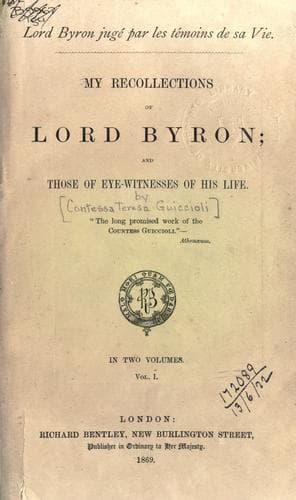
My Recollections of Lord ByronGuiccioli, Teresa, contessa di
General
My Recollections of Lord Byron
Guiccioli, Teresa, contessa di
Byron, George Gordon Byron, Baron, 1788-1824; Poets, English -- 19th century -- Biography
"Fletcher may have informed you about his happy state of mind in his
last moments. He often repeated subjects from the Testament, and when,
in his last moments, he had in vain attempted to make known his wishes
with respect to his daughter, and others most dear to him in life, and
when, on account of the wanderings of his mind, he could not succeed in
making himself understood, Fletcher answered him, 'Nothing is nearer my
heart than to execute your wishes; but, unfortunately, I have scarcely
been able to comprehend half of them.' 'Is it possible?' he replied.
'Alas! it is too late. How unfortunate! Not my will, but the will of God
be done.' There remained to him only a few intervals of reason and
interruptions of delirium, the effect of determination of blood to the
head.
"He often expressed to me the contempt which he felt for those called
_esprits forts_ (a set of ignorant egotists, incapable of any generous
action, and hypocrites themselves), in their affected contempt of every
faith.
"He professed a complete toleration, and a particular respect for every
sincere conviction. He would have deemed it an unpardonable crime to
detach any one persuaded of the truth from his belief, although it might
be tinctured with absurdity, because he believed it could lead to no
other end than to render him an infidel."
After so many proofs of Byron's religious tendencies, is it not right to
ask, What was that skepticism of which so much has been said that it has
been almost received as a fact by the world generally? Did he not
believe in the necessity of religion? In a God, Creator of all things?
In the spirituality, and therefore immortality, of the soul? In our
liberty of action, and our moral responsibility? We have seen what
others have said on each of these subjects; let us now see what he said
himself upon the subject. But some will object, "Are you going to judge
of his views from his poetry? Can one attach much importance to opinions
expressed in verse? Do not poets often say that which they do not think,
but which genius inspires them to write? Are such dictates to be
considered as their own views?" Such objections may be valid, and we
shall so far respect them, therefore, as to dismiss Lord Byron's poetry,
and treat only of that which he has written in prose: we will not
consider him when under the influence of inspiration and of genius, but
when given up entirely to the silent examination of his conscience. What
did his thorough good sense tell him about religion in general? The
following note, in which he repels the stupid and wicked attacks of
Southey, who called him a skeptic, will prove it:--
Public-domain text, read in full here on John Shaqi.
Reviews
Reviews
No reviews yet
Be the first to share your thoughts on this work.
Elsewhere in the archive
Join the Discussion
Join the discussion
Sign in to leave a comment or review.
Sign InorCreate an account