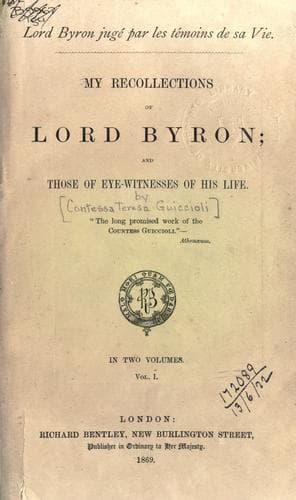
My Recollections of Lord ByronGuiccioli, Teresa, contessa di
General
My Recollections of Lord Byron
Guiccioli, Teresa, contessa di
Byron, George Gordon Byron, Baron, 1788-1824; Poets, English -- 19th century -- Biography
"One mode of worship yields to another, but there never will be a
country without a worship of some sort. Some will instance France; but
the Parisians alone, and a fanatical faction of them, maintained for a
short time the absurd dogma of theophilanthropy. If the English Church
is upset, it will be by the hands of its own sectaries, not by those of
skeptics. People are too wise, too well informed, to submit to an
impious unbelief. There may exist a few speculators without faith; but
they are small in numbers, and their opinions, being without enthusiasm
or appeal to the passions, can not make proselytes unless they are
persecuted, that being the only means of augmenting any sects."
"'I am always,' he writes in his memorandum, 'most religious upon a
sunshiny day, as if there were some association, some internal approach
to greater light and purity and the kindler of this dark lantern of our
existence.
"'The night had also a religious influence, and even more so when I
viewed the moon and stars through Herschel's telescope, and saw that
they were worlds.'"
And what thought Byron of the existence of God? "Supposing even," he
says, "that man existed before God, even his higher pre-Adamite
supposititious creation must have had an origin and a creator, for a
creation is a more natural imagination than a fortuitous concourse of
atoms; all things remount to a fountain, though they may flow to an
ocean.
"If, according to some speculations, you could prove the world many
thousand years older than the Mosaic chronology, or if you could get rid
of Adam and Eve, and the apple, and serpent, still what is to be set up
in their stead? or how is the difficulty removed? Things must have had a
beginning, and what matters it when or how?"
If Byron did not question the existence of God, did he doubt the
spirituality and immortality of the soul? Here are some of his
answers:--
"What is poetry?" he asked himself in his memorandum, and he
replied--"The feeling of a former world and future." And further, in the
same memorandum:--
Public-domain text, read in full here on John Shaqi.
Reviews
Reviews
No reviews yet
Be the first to share your thoughts on this work.
Elsewhere in the archive
Join the Discussion
Join the discussion
Sign in to leave a comment or review.
Sign InorCreate an account