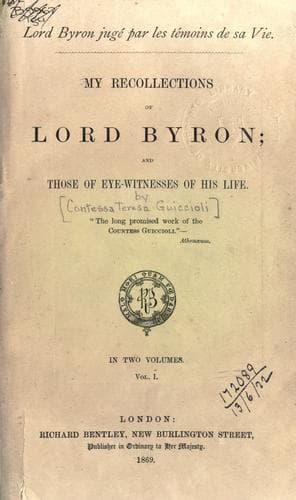
My Recollections of Lord ByronGuiccioli, Teresa, contessa di
General
My Recollections of Lord Byron
Guiccioli, Teresa, contessa di
Byron, George Gordon Byron, Baron, 1788-1824; Poets, English -- 19th century -- Biography
The same gratitude was shown by Byron to Mary Gray's sister, who had
been his first nursery governess. He wrote to her after he had left
Scotland, to ask news of her, and to announce with delight that he could
now put on an ordinary shoe--an event, he said, which he had greatly
looked forward to, and which he was sure it would give her pleasure to
hear.
Before going to school at Aberdeen, Byron had two tutors, Ross and
Paterson, both young, intelligent, and amiable ecclesiastics, for whom
he always entertained a pleasing and affectionate remembrance.
At seven years of age he went to the Aberdeen Grammar School, and the
general impression which he left there, as evinced by the testimony of
several of his colleagues who are still living, was, says Moore, "that
he was quick, courageous, passionate, to a remarkable degree venturous
and fearless, but affectionate and companionable.
"He was most anxious to distinguish himself among his school-fellows by
prowess in all sports and exercises, but, though quick when he could be
persuaded to attend, he was in general very low in his class, nor seemed
ambitious of being promoted higher."
The anecdotes told of him at this time all prove his fine nature, and
show the goodness and greatness of soul which characterized him up to
his last day.
All the qualities which are to shine in the man will be found already
marked in the child. On one occasion he was taken to see a piece at the
Edinburgh theatre, in which one of the actors pretends that the moon is
the sun. The child, notwithstanding his timidity, was shocked by this
insult to his understanding, rose from his seat, and cried out, "I
assure you, my dear sir, that it is the moon." Here, again, we can trace
that love of truth which in after life made him so courageous in its
proclamation at any cost.
When, at Aberdeen, he was, on one occasion, styled Dominus Byron in the
school-room, by way of announcing to him his accession to the title, the
child began to cry. Can not these tears be explained by the mixture of
pleasure and pain which he must have felt at that moment--pleasure at
becoming a peer, and distress at not being able to share this pleasure
with his comrades? Are they not a prelude of the sacrifice of himself
which he afterward made by actually placing himself in the wrong, in
order that at the time of his greatest triumph his rivals might not be
too jealous of him?
Public-domain text, read in full here on John Shaqi.
Reviews
Reviews
No reviews yet
Be the first to share your thoughts on this work.
Elsewhere in the archive
Join the Discussion
Join the discussion
Sign in to leave a comment or review.
Sign InorCreate an account