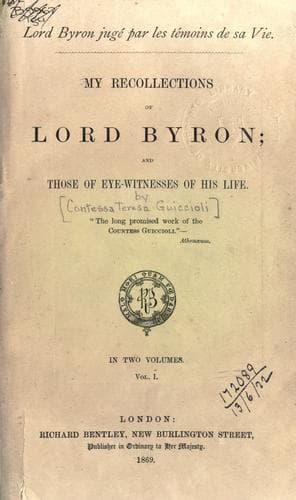
My Recollections of Lord ByronGuiccioli, Teresa, contessa di
General
My Recollections of Lord Byron
Guiccioli, Teresa, contessa di
Byron, George Gordon Byron, Baron, 1788-1824; Poets, English -- 19th century -- Biography
Lord Byron's goodness, however, was so exceptional, and contrasted so
strongly with the qualities attributed to him by those who only knew him
by repute, that, in making an exception of him, astonishment, at the
very least, might have been the result. If we look at him
conscientiously in every act of his life, in his letters, and in his
poetry, we must sympathize particularly with him. We find that his
goodness shines as prominently as does his genius, and we feel that it
can bear any test at any epoch of, alas! his too short existence. As,
however, I do not purpose here to write his biography, I shall confine
myself merely to a few instances, and will give only a few proofs taken
from his early life. To no one can the words of Alfieri be better
applied than to Byron:--"He is the continuation of the child"--an idea
which has been expressed even more elegantly of late by Disraeli, in his
"Literary Characters:"--
"As the sun is seen best at its rising and its setting, so men's native
dispositions are clearly perceived while they are children, and when
they are dying."
LORD BYRON'S CHILDHOOD.
Of those who have written Byron's life, the best disposed among them
have not sufficiently noticed his admirable perfection of character when
a child, as revealed to us by sundry anecdotes and by his own poems,
entitled "Hours of Idleness:"--
"There was in his disposition," says Moore, "as appears from the
concurrent testimony of nurses, tutors, and all who were employed about
him, a mixture of affectionate sweetness and playfulness, by which it
was impossible not to be attached, and which rendered him then, as in
his riper years, easily manageable by those who loved and understood him
sufficiently to be at once gentle and firm enough for the task. The
female attendant whom he had taken the most fancy to was the youngest of
two sisters, named Mary Gray, and she had succeeded in gaining an
influence over his mind against which he very rarely rebelled."
By an accident which occurred at the time of his birth one of his feet
was twisted out of its natural position, and, to restore the limb to
shape, expedients were used under the direction of the celebrated Dr.
Hunter. Mary Gray, to whom fell the task of putting on the bandages at
bed-time, used to sing him to sleep, or tell him Scotch ballads and
legends, in which he delighted, or teach him psalms, and thus lighten
his pain. Mary Gray was a very pious woman, and she unquestionably
inspired Byron with that love of the Scriptures which he preserved to
his last day. She only parted from Byron when he was placed at school at
Dulwich, in 1800. The child loved her as she loved him. He gave her his
watch, and, later, sent her his portrait. Both these treasures were
given to Dr. Ewing (an enthusiast of Byron, who had collected the dying
words of Mary Gray, which were all for the child she had nursed), by her
grateful husband.
Public-domain text, read in full here on John Shaqi.
Reviews
Reviews
No reviews yet
Be the first to share your thoughts on this work.
Elsewhere in the archive
Join the Discussion
Join the discussion
Sign in to leave a comment or review.
Sign InorCreate an account