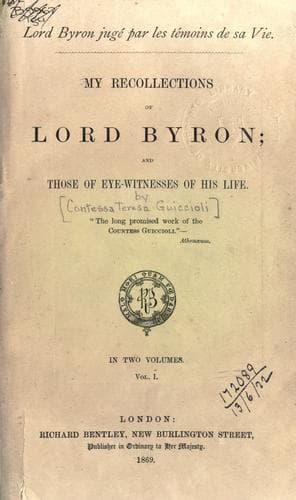
My Recollections of Lord ByronGuiccioli, Teresa, contessa di
General
My Recollections of Lord Byron
Guiccioli, Teresa, contessa di
Byron, George Gordon Byron, Baron, 1788-1824; Poets, English -- 19th century -- Biography
"Our conversation was renewed and continued from that time till his
going abroad. Whatever faults Lord Byron may have exhibited toward
others, to myself he was always uniformly affectionate.... I can not
call to mind a single instance of caprice or unkindness in the whole
course of our intimacy to allege against him."
The fault to which Harness alludes, and which he acknowledges, was one
of the kind to which Byron was most sensitive, namely, coldness. Having
lost some of his early and best friends, Edward Long, and all the others
being spread far and near, abroad and in England, following out their
respective careers and destiny, Harness was about the only early friend
he had near him.
The time was approaching when he was going to leave England, to travel
and to learn by study the great book of Nature. His heart was wounded by
the injustice which had been done him, by the many disenchantments which
he had experienced, by the brutal criticism of his "Hours of Idleness"
from the pen of his relation Lord Carlisle, and by his money
difficulties. Unable as yet to foretell the effects of his satire, which
had not yet appeared, and the success of which might have consoled him a
little for past mortifications, he found in friendship his sole relief,
and particularly in the friendship of Harness. At this very critical
time, Harness--(be it either through the influence of his family and
relations, or through a notion that his principles were rather unsuited
to the heterodox opinions of Lord Byron)--behaved coldly toward Byron.
Dallas, however, who from puritanism and family pride, and even from
jealousy, was rather an enemy of Lord Byron's intellectual
friends--(contending that it was they who had instilled into Byron all
the anti-orthodox views which the poet had adopted)--makes an exception
in favor of Harness.
Byron spoke of Harness with an affection which he hoped was repaid to
him. I often met him at Newstead, and both he and Byron had had their
portraits taken, which they were to make a present of to one another. It
was not until some unknown cause sprung up to establish a coldness
between the two friends that their intimacy ceased, and at the same time
Harness's visits to Newstead. Byron felt it very keenly.
In what degree the conduct of Harness hurt Lord Byron and contributed to
those explosions of misanthropy which, slight and passing as they were,
have nevertheless been urged as a reproach against his first and second
cantos of "Childe Harold," I shall examine later.
Public-domain text, read in full here on John Shaqi.
Reviews
Reviews
No reviews yet
Be the first to share your thoughts on this work.
Elsewhere in the archive
Join the Discussion
Join the discussion
Sign in to leave a comment or review.
Sign InorCreate an account