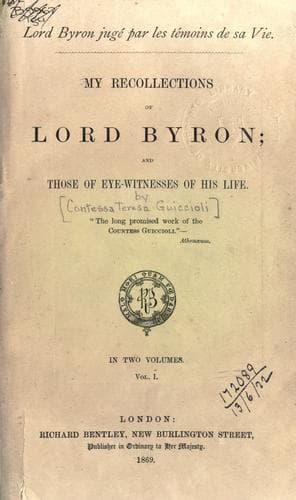
My Recollections of Lord ByronGuiccioli, Teresa, contessa di
General
My Recollections of Lord Byron
Guiccioli, Teresa, contessa di
Byron, George Gordon Byron, Baron, 1788-1824; Poets, English -- 19th century -- Biography
Here it is only necessary to say that in a soul such as his, where
rancor could never live, such a coldness wounded him without altering
his sentiments in any way. After two years' absence he returned to
England, and so heartily forgave Harness that he actually wished to
dedicate to him the first two cantos of "Childe Harold," and only gave
up this idea from a generous fear that its dedication might injure him
in his clerical profession, on account of certain stanzas in the poem
which were not quite orthodox.
"The letter," says Moore, "in which he expresses these delicate
sentiments is, unfortunately, lost."
Some months after his return to England he resumed his correspondence
with Harness, and both the friends assembled at Newstead. Harness,
however, as a clergyman, was severe in his judgments. Byron wrote to
him:--
"You are censorious, child: when you are a little older, you will learn
to dislike every body, but abuse nobody.... I thank you most truly for
the concluding part of your letter. I have been of late not much
accustomed to kindness from any quarter, and I am not the less pleased
to meet with it again from one to whom I had known it earliest. I have
not changed in all my ramblings; Harrow, and of course yourself, never
left me, and the
'Dulces reminiscitur Argos.'
attended me to the very spot to which that sentence alludes in the mind
of the fallen Argive. Our intimacy began before we began to date at all,
and it rests with you to continue it till the hour which must number it
and me with the things that were."
Two days afterward, he writes to him again a letter full of endearing
expressions, couched in a friendly tone of interest, of which the
following extracts are instances:--
"And now, child, what art thou doing? Reading, I trust. I want to see
you take a degree. Remember, this is the most important period of your
life; and don't disappoint your papa and your aunt and all your kin,
besides myself.
"You see, _mio carissimo_, what a pestilent correspondent I am likely to
become; but then you shall be as quiet at Newstead as you please, and I
won't disturb your studies as I do now."
On the 11th of December, of the same year, he invites Moore to Newstead
and says, "H---- will be here, and a young friend named Harness, the
earliest and dearest I ever had from the third form at Harrow to this
hour."
And, finally, he wrote to Harness that he had no greater pleasure than
to hear from him; indeed, that it was more than a pleasure.
HIS LATER FRIENDS.
When he had reached his nineteenth year, which was the second of his
stay at Cambridge, Byron (having lost sight of most of his Harrow
friends to whom he dedicated his verses, and having lost both Long and
Eddleston) suddenly found himself launched into the vortex of a
university life, for which he had no liking. Happily, however, he was
thrown among young men of great distinction, whom fate had then gathered
at Cambridge.
Public-domain text, read in full here on John Shaqi.
Reviews
Reviews
No reviews yet
Be the first to share your thoughts on this work.
Elsewhere in the archive
Join the Discussion
Join the discussion
Sign in to leave a comment or review.
Sign InorCreate an account