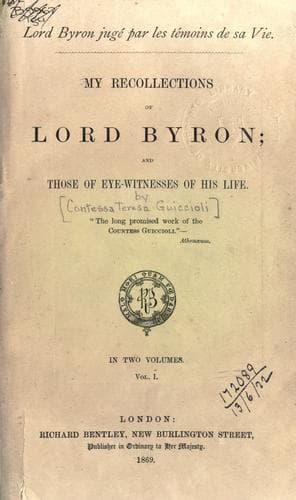
My Recollections of Lord ByronGuiccioli, Teresa, contessa di
General
My Recollections of Lord Byron
Guiccioli, Teresa, contessa di
Byron, George Gordon Byron, Baron, 1788-1824; Poets, English -- 19th century -- Biography
It has been our fortune to traverse together, at various periods,
the countries of chivalry, history, and fable--Spain, Greece, Asia
Minor, and Italy; and what Athens and Constantinople were to us a
few years ago, Venice and Rome have been more recently. The poem
also, or the pilgrim, or both, have accompanied me from first to
last; and perhaps it may be a pardonable vanity which induces me to
reflect with complacency on a composition which in some degree
connects me with the spot where it was produced, and the objects it
would fain describe; and however unworthy it may be deemed of those
magical and memorable abodes, however short it may fall of our
distant conceptions and immediate impressions, yet as a mark of
respect for what is venerable, and of feeling for what is glorious,
it has been to me a source of pleasure in the production, and I
part with it with a kind of regret, which I hardly suspected that
events could have left me for imaginary objects.
With regard to the conduct of the last canto, there will be found
less of the pilgrim than in any of the preceding, and that little
slightly, if at all, separated from the author speaking in his own
person. The fact is, that I had become weary of drawing a line
which every one seemed determined not to perceive: like the Chinese
in Goldsmith's "Citizen of the World," whom nobody would believe to
be a Chinese, it was in vain that I asserted, and imagined that I
had drawn, a distinction between the author and the pilgrim; and
the very anxiety to preserve this difference, and disappointment at
finding it unavailing, so far crushed my efforts in the
composition, that I determined to abandon it altogether--and have
done so. The opinions which have been, or may be, formed on that
subject, are _now_ a matter of indifference: the work is to depend
on itself and not on the writer; and the author, who has no
resources in his own mind beyond the reputation, transient or
permanent, which is to arise from his literary efforts, deserves
the fate of authors.
In the course of the following canto it was my intention, either in
the text or in the notes, to have touched upon the present state of
Italian literature, and perhaps of manners. But the text, within
the limits I proposed, I soon found hardly sufficient for the
labyrinth of external objects, and the consequent reflections; and
for the whole of the notes, excepting a few of the shortest, I am
indebted to yourself, and these were necessarily limited to the
elucidation of the text.
Public-domain text, read in full here on John Shaqi.
Reviews
Reviews
No reviews yet
Be the first to share your thoughts on this work.
Elsewhere in the archive
Join the Discussion
Join the discussion
Sign in to leave a comment or review.
Sign InorCreate an account