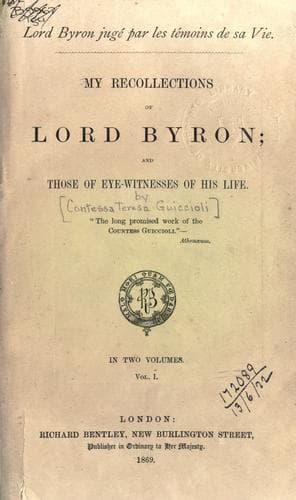
My Recollections of Lord ByronGuiccioli, Teresa, contessa di
General
My Recollections of Lord Byron
Guiccioli, Teresa, contessa di
Byron, George Gordon Byron, Baron, 1788-1824; Poets, English -- 19th century -- Biography
It is also a delicate, and no very grateful task, to dissert upon
the literature and manners of a nation so dissimilar; and requires
an attention and impartiality which would induce us--though perhaps
no inattentive observers, nor ignorant of the language or customs
of the people among whom we have recently abode--to distrust, or at
least defer our judgment, and more narrowly examine our
information. The state of literary as well as political party
appears to run, or to _have_ run, so high, that for a stranger to
steer impartially between them is next to impossible. It may be
enough then, at least for my purpose, to quote from their own
beautiful language--"Mi pare che in un paese tutto poetico, che
vanta la lingua la piu nobile ed insieme la piu dolce, tutte tutte
le vie diverse si possouo tentare, e che sinche la patria di
Alfieri e di Monti non ha perduto l'antico valore, in tutte essa
dovrebbe essere la prima." Italy has great names still: Canova,
Monti, Ugo Foscolo, Pindemonte, Visconti, Morelli, Cicognara,
Albrizzi, Mezzophanti, Mai, Mustoxidi, Aglietti, and Vacca, will
secure to the present generation an honorable place in most of the
departments of art, sciences, and belles-lettres; and in some the
very highest. Europe--the World--has but one Canova.
It has been somewhere said by Alfieri, that "La pianta uomo nasce
piu robusta in Italia che in qualunque altra terra--e che gli
stessi atroci delitti che vi si commettono ne sono una prova."
Without subscribing to the latter part of his proposition--a
dangerous doctrine, the truth of which may be disputed on better
grounds, namely, that the Italians are in no respect more ferocious
than their neighbors--that man must be willfully blind, or
ignorantly heedless, who is not struck with the extraordinary
capacity of this people, or, if such a word be admissible, their
_capabilities_, the facility of their acquisitions, the rapidity of
their conceptions, the fire of their genius, their sense of beauty,
and amid all the disadvantages of repeated revolutions, the
desolation of battles, and the despair of ages, their still
unquenched "longing after immortality"--the immortality of
independence. And when we ourselves, in riding round the walls of
Rome, heard the simple lament of the laborers' chorus, "Roma! Roma!
Roma! Roma non e piu come era prima," it was difficult not to
contrast this melancholy dirge with the bacchanal roar of the songs
of exultation still yelled from the London taverns, over the
carnage of Mont St. Jean, and the betrayal of Genoa, of Italy of
France, and of the world, by men whose conduct you yourself have
exposed in a work worthy of the better days of our history. For
me,--
"Non movero mai corda
Ove la turba di sue ciance assorda."
Public-domain text, read in full here on John Shaqi.
Reviews
Reviews
No reviews yet
Be the first to share your thoughts on this work.
Elsewhere in the archive
Join the Discussion
Join the discussion
Sign in to leave a comment or review.
Sign InorCreate an account