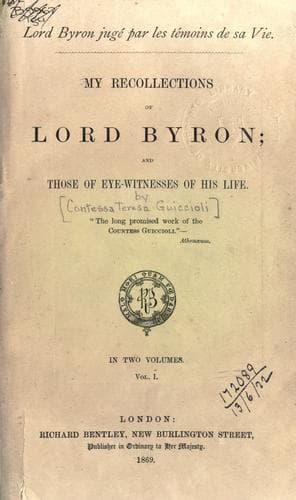
My Recollections of Lord ByronGuiccioli, Teresa, contessa di
General
My Recollections of Lord Byron
Guiccioli, Teresa, contessa di
Byron, George Gordon Byron, Baron, 1788-1824; Poets, English -- 19th century -- Biography
What Italy has gained by the late transfer of nations, it were
useless for Englishmen to inquire, till it becomes ascertained that
England has acquired something more than a permanent array and a
suspended Habeas Corpus; it is enough for them to look at home. For
what they have done abroad, and especially in the south "verily
they _will have_ their reward," and at no very distant period.
Wishing you, my dear Hobhouse, a safe and agreeable return to that
country whose real welfare can be dearer to none than to yourself,
I dedicate to you this poem in its completed state; and repeat once
more how truly I am ever, your obliged and affectionate friend,
BYRON.
MATTHEWS.
"Of this remarkable young man, Charles Skinner Matthews," says Moore, "I
have already had occasion to speak; but the high station which he held
in Lord Byron's affection and admiration may justify a somewhat ampler
tribute to his memory.
"There have seldom, perhaps, started together in life so many youths of
high promise and hope as were to be found among the society of which
Lord Byron formed a part at Cambridge. Among all these young men of
learning and talent, the superiority in almost every department of
intellect seems to have been, by the ready consent of all, awarded to
Matthews.... Young Matthews appears--in spite of some little asperities
of temper and manner, which he was already beginning to soften down when
snatched away--to have been one of those rare individuals who, while
they command deference, can at the same time win regard, and who, as it
were, relieve the intense feeling of admiration which they excite by
blending it with love."
Matthews died while bathing in the Cam.
On the 7th of September, 1811, Byron wrote to Dallas as
follows:--"Matthews, Hobhouse, Davies, and myself, formed a coterie of
our own at Cambridge and elsewhere.... Davies, who is not a scribbler,
has always beaten us all in the war of words. H---- and myself always
had the worst of it with the other two, and even M---- yielded to the
dashing vivacity of S. D----."
And in another letter:--"You did not know M----: he was a man of the
most astonishing powers."
And again, speaking of his death to Mr. Hodgson, he writes:--
"You will feel for poor Hobhouse; Matthews was the god of his idolatry:
and if intellect could exalt a man above his fellows, no one would
refuse him pre-eminence."
Matthews died at the time when he was offering himself to compete for a
lucrative and honorable position in the University. As soon as his death
was known, it was said that if the highest talents could be sure of
success, if the strictest principles of honor, and the devotion to him
of a multitude of friends could have assured it, his dream would have
been realized.
Public-domain text, read in full here on John Shaqi.
Reviews
Reviews
No reviews yet
Be the first to share your thoughts on this work.
Elsewhere in the archive
Join the Discussion
Join the discussion
Sign in to leave a comment or review.
Sign InorCreate an account