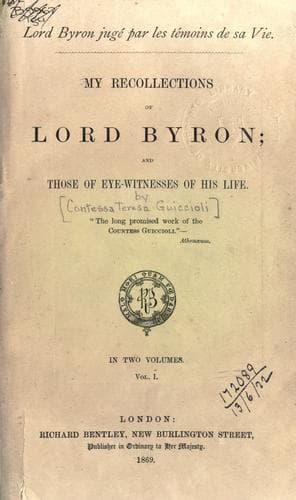
My Recollections of Lord ByronGuiccioli, Teresa, contessa di
General
My Recollections of Lord Byron
Guiccioli, Teresa, contessa di
Byron, George Gordon Byron, Baron, 1788-1824; Poets, English -- 19th century -- Biography
To conquer this repugnance he required a very high degree of esteem for
the friend he was about to make, a similarity of tastes, and above all
a sympathy based upon real goodness. This was the time of his greatest
mental depression. It preceded that splendid epoch in his life, when his
star shone with such brilliancy in the literary sphere, thanks to
"Childe Harold," and in the world of politics through his parliamentary
successes, which had earned for him the praises of the whole nation.
Then did friends present themselves in scores, but out of these few were
chosen.
Among the great men of the day who surrounded him, he took to several,
and in particular to Lord Holland, a Whig like himself, and a man
equally distinguished for the excellence of his heart as for his rare
intellect. Lord Holland's hospitality was the pride of England. Byron
also conceived a liking for Lord Lansdowne,--the model of every virtue,
social and domestic; for Lord Dudley, whose wit so charmed him; for Mr.
Douglas Kinnaird, brother to Lord Kinnaird, whom Byron called his most
devoted friend in politics and in literature; for all those first
notabilities of the day, Rogers, Sheridan, Curran, Mackintosh, for all
of whom he may be said to have entertained a feeling akin to friendship.
But all these were friends of the moment; friends whom the relations of
every-day life in the world of fashion had brought together, and whose
talents exacted admiration, and hence he formed ties which may be styled
friendship, provided the strict sense of that word is not understood.
Byron felt this more than any one.
One man, however, contrived to get such a hold on his mind and heart,
that he became truly his friend, and exercised a salutary influence over
him. This man, who contributed to dispel the dark clouds which hung over
Byron's mind, and was the first to charm him in his new life of fashion,
was no other than Thomas Moore.
This new intimacy had not, it is true, the freshness of his early
friendships, formed, as these were, in the freshness of a young heart,
and therefore without any worldly calculations. Moore was even ten years
his senior. But his affection for Moore, founded as it was upon a
similarity of tastes, upon mutual reminiscences, esteem and admiration,
soon developed itself into a friendship which never changed. The
circumstances under which Byron and Moore became friends speak too
highly for the credit of both not to be mentioned here, and we must
therefore say a few words on the subject.
Byron, as the reader knows, had in his famous satire of "English Bards,"
etc., attacked the poems of Moore as having an immoral tendency. Instead
of interpreting the beautiful Irish melodies in their figurative sense,
Byron had taken the direct sense conveyed in their love-inspiring words,
and considered them as likely to produce effeminate and unhealthy
impressions.
Public-domain text, read in full here on John Shaqi.
Reviews
Reviews
No reviews yet
Be the first to share your thoughts on this work.
Elsewhere in the archive
Join the Discussion
Join the discussion
Sign in to leave a comment or review.
Sign InorCreate an account