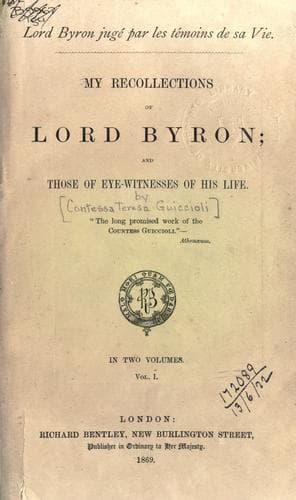
My Recollections of Lord ByronGuiccioli, Teresa, contessa di
General
My Recollections of Lord Byron
Guiccioli, Teresa, contessa di
Byron, George Gordon Byron, Baron, 1788-1824; Poets, English -- 19th century -- Biography
"Who in soft guise, surrounded by a choir
Of virgins melting, not to Vesta's fire,
With sparkling eyes, and cheek by passion flush'd,
Strikes his wild lyre, while listening dames are hush'd?
'Tis Little! young Catullus of his day,
As sweet, but as immoral, in his lay!
* * * * * * *
Yet kind to youth,...
She bids thee 'mend thy line and sin no more.'"
Lord Byron was always of opinion that literature, when it tends to exalt
the more tender sentiments of our nature, pure as these may be, is ever
injurious to the preservation of those manly and energetic qualities
which are so essential for the accomplishment of a noble mission here
below. This opinion is illustrated by the occasional extreme energy of
his heroes, and by his repugnance to introduce love into his dramas. If
this reproach offended Moore a little, Lord Byron's allusion to his duel
with Jeffrey at Chalk Farm in 1806, where it was said that the pistols
of each were not loaded, must have wounded him still more, and he wrote
a letter to Lord Byron which must, it would seem, have brought on a
duel.
Lord Byron was then travelling in the Levant, and the letter remained
with his agent in London. It was only two years after, on his return
from his travels, that he received it. An exchange of letters with Moore
took place, and such was the "good sense, self-possession and frankness"
of Byron's conduct in the matter, that Moore was quite pacified, and all
chances of a duel disappeared with the reconciliation of both, at the
request of each.
The reconciliation took place under the auspices of Rogers, and at a
dinner given by the latter for that purpose. After speaking of his
extraordinary beauty, and of the delicacy and prudence of his conduct,
Moore, in referring to this dinner, ends by saying, "Such did I find
Lord Byron on my first experience of him, and such, so open and
manly-minded did I find him to the last."
Byron, too, was influenced by the charm of Moore's acquaintance, and so
dear to him became the latter's society through that kind of electric
current which appears to run through some people and forms between them
an unbounded sympathy, that it actually succeeded in dispelling the
sombre ideas which then possessed his soul.
Their similarity of tastes, and at the same time those differences of
character which are so essential to the development of the intellect of
two sympathetic minds, were admirably adapted to form the charm which
existed in their relations with one another.
Public-domain text, read in full here on John Shaqi.
Reviews
Reviews
No reviews yet
Be the first to share your thoughts on this work.
Elsewhere in the archive
Join the Discussion
Join the discussion
Sign in to leave a comment or review.
Sign InorCreate an account