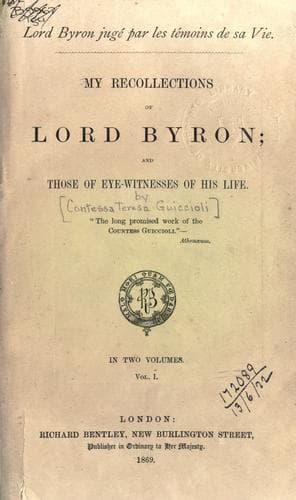
My Recollections of Lord ByronGuiccioli, Teresa, contessa di
General
My Recollections of Lord Byron
Guiccioli, Teresa, contessa di
Byron, George Gordon Byron, Baron, 1788-1824; Poets, English -- 19th century -- Biography
When he published the "Bride of Abydos," Moore remarked that there
existed some connection in that poem with an incident he had to
introduce in his own poem of "Lalla Rookh." He wrote thereupon to Byron
to say that he would stop his own work, because to aspire after him to
describe the energy of passion would be the work of a Caesar.
Byron replied:--
"I see in you what I never saw in poet before, a strange diffidence of
your own powers, which I can not account for, and which must be
unaccountable when a Cossack like me can appall a cuirassier.
"Go on--I shall really be very unhappy if I at all interfere with you.
The success of mine is yet problematical ... Come out, screw your
courage to the sticking-place--no man stands higher, whatever you may
think on a rainy day in your provincial retreat."
To Moore he dedicated his "Corsair," and to read the preface is to see
how sincerely attached Byron was to his friend.
When at Venice he heard of some domestic affliction which had befallen
Moore; he wrote to him with that admirable simplicity of style which can
not be imitated, because the true accents of the heart defy imitation.
"Your domestic afflictions distress me sincerely; and, as far as you are
concerned, my feelings will always reach the furthest limits to which I
may still venture. Throughout life your losses shall be mine, your gains
mine also, and, however much I may lose in sensibility, there will
always remain a drop of it for you."
When Moore obtained his greatest success, and arrived at the summit of
popularity, by the publication of "Lalla Rookh," Byron's pleasure was
equal to the encouragements he had given him. But of his noble soul, in
which no feeling of jealousy could enter, we shall speak elsewhere.
Here, in conclusion, I must add that his friendship for Moore remained
stanch through time and circumstances, and even notwithstanding Moore's
wrongs toward him, of which I shall speak in another chapter.
In treating of Byron's friendships, I have endeavored to in set forth
the wrongs which some of his friends, and Moore particular, have
committed against him both before and after his death.
If, as Moore observes, it be true that Byron never lost a friend, was
their friendship a like friendship with his own? Has it ever gone so far
as to make sacrifices for his sake, and has not Lord Byron ever given
more as a friend than he ever received in return? Had he found in his
friendship among men that reciprocity of feeling which he ever found
among women, would so many injuries and calumnies have been heaped upon
his head? Would not his friends, had they shown a little more warmth of
affection, have been able to silence those numerous rivals who rendered
his life a burden to him? Had they been conscientious in their opinions,
they would certainly not have drawn upon them the rather bitter lines in
"Childe Harold:"--
Public-domain text, read in full here on John Shaqi.
Reviews
Reviews
No reviews yet
Be the first to share your thoughts on this work.
Elsewhere in the archive
Join the Discussion
Join the discussion
Sign in to leave a comment or review.
Sign InorCreate an account