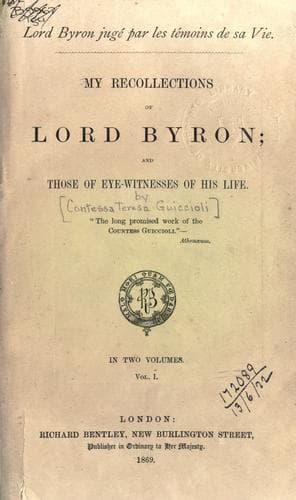
My Recollections of Lord ByronGuiccioli, Teresa, contessa di
General
My Recollections of Lord Byron
Guiccioli, Teresa, contessa di
Byron, George Gordon Byron, Baron, 1788-1824; Poets, English -- 19th century -- Biography
Then, according to his habitual custom of ever depreciating himself
morally, he writes to Moore, in answer to the latter's compliments about
his goodness: "But they say the devil is amusing when pleased, and I
must have been more venomous than the old serpent, to have hissed or
stung in your company."
His sympathy for Moore went so far as to induce him to believe that he
was capable of every thing that is good.
"Moore," says he, in his memoranda of 1813, "has a reunion of
exceptional talents--poetry, music, voice, he has all--and an expression
of countenance such as no one will ever have.
"What humor in his poet's bag! There is nothing that Moore can not do if
he wishes.
"He has but one fault, which I mourn every day--he is not here."
He even liked to attribute to Moore successes which the latter only owed
to himself. Byron had, as the reader knows, the most musical of voices.
Once heard, it could not be forgotten.[26] He had never learned music,
but his ear was so just, that when he hummed a tune his voice was so
touching as to move one to tears.
"Not a day passes," he wrote to Moore, "that I don't think and speak of
you. You can not doubt my sincere admiration, waiving personal
friendship for the present. I have you by rote and by heart, of which
_ecce signum_."
He then goes on to tell him his adventure when at Lady O----'s:--
"I have a habit of uttering, to what I think tunes, your 'Oh, breathe
not,' and others; they are my matins and vespers. I did not intend them
to be overheard, but one morning in comes not la Donna, but il Marita,
with a very grave face, and said, 'Byron, I must request you not to sing
any more, at least of those songs.'--'Why?'--'They make my wife cry, and
so melancholy that I wish her to hear no more of them.'
"Now, my dear Moore, the effect must have been from your words, and
certainly not my music."
To give Moore the benefit of effecting a great success with an Oriental
poem, Byron gave up his own idea of writing one, and sent him some
Turkish books.
"I have been thinking of a story," says he, "grafted on the amours of a
Peri and a mortal, something like Cayotte's 'Diable Amoureux.'
Tenderness is not my _forte_; for that reason I have given up the idea,
but I think it a subject you might make much of."
Moore actually wished to write a poem on an Oriental subject, but
dreaded such a rival as Byron, and expressed his fears in writing to
him. Byron replied:--
"Your Peri, my dear Moore, is sacred and inviolable. I have no idea of
touching the hem of her petticoat. Your affectation of a dislike to
encounter me is so flattering that I begin to think myself a very fine
fellow. But it really puts me out of humor to hear you talk thus."
Not only did Byron encourage Moore in his task, but effaced himself
completely in order to make room for him.
Public-domain text, read in full here on John Shaqi.
Reviews
Reviews
No reviews yet
Be the first to share your thoughts on this work.
Elsewhere in the archive
Join the Discussion
Join the discussion
Sign in to leave a comment or review.
Sign InorCreate an account