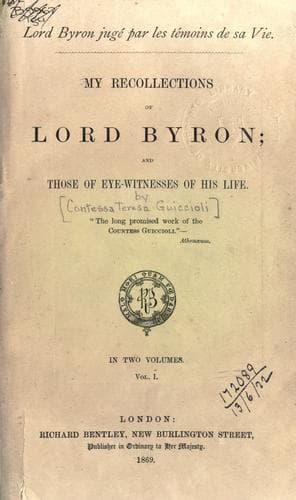
My Recollections of Lord ByronGuiccioli, Teresa, contessa di
General
My Recollections of Lord Byron
Guiccioli, Teresa, contessa di
Byron, George Gordon Byron, Baron, 1788-1824; Poets, English -- 19th century -- Biography
From that moment an enthusiasm for her father filled her whole soul. She
shut herself up for hours in the rooms which he had inhabited, and which
were still filled with the things which he had used. Here she devoted
herself to her favorite studies. She chose to sleep in the apartments
which were most particularly hallowed by the reminiscences of her
father, and appeared never to have been happier than during this stay at
Newstead, absorbed as she had become for the first time in all the glory
of him whose tenderness for her had been so carefully concealed from
her. From that time all appeared insipid and tasteless to her; existence
became a pain. Every thing told her of her father's renown, and nothing
could replace it. All these feelings so possessed her that she fell ill,
and when she was on the point of death she wrote to Colonel Wildman to
beg that she might be buried next to her illustrious father. There, in
the modest village church of Hucknell, lie the father and the daughter,
who, separated from one another during their lifetime, became united in
death, and thus were realized, in a truly prophetic way, the words which
close the admirable third canto of "Childe Harold's Pilgrimage." Words
of consolation for those who loved Byron, and whom religion and
philosophy inspire with hope; for they think that, despite his enemies,
this union of their mortal remains must be the symbol of their union
above, and that the prophetic sense of the words pronounced in the agony
of despair will be realized by an eternal happiness.
CXVII.
"Yet, though dull Hate as duty should be taught,
I know that thou wilt love me; though my name
Should be shut from thee, as a spell still fraught
With desolation, and a broken claim:
Though the grave closed between us,--'twere the same,
I know that thou wilt love me; though to drain
_My_ blood from out thy being were an aim
And an attainment,--all would be in vain,--
Still thou would'st love me, still that more than life retain."
LORD BYRON AS A BROTHER.
Fraternal love was no less conspicuous in him than his paternal
affection. It may be easily conceived how great must have been the
influence over one who cared so much for friends in general, of that
affection which is the perfection of love, and, at the same time, the
most delicate, peaceful, and charming of sentiments. Such a love has
neither misunderstandings to dread, nor misrepresentations to fear. It
is above the caprices, ennui, and changes which often rule the
friendships of our choice.
Public-domain text, read in full here on John Shaqi.
Reviews
Reviews
No reviews yet
Be the first to share your thoughts on this work.
Elsewhere in the archive
Join the Discussion
Join the discussion
Sign in to leave a comment or review.
Sign InorCreate an account