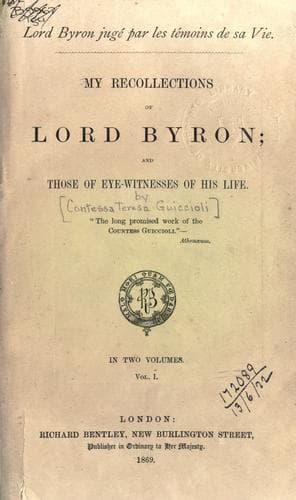
My Recollections of Lord ByronGuiccioli, Teresa, contessa di
General
My Recollections of Lord Byron
Guiccioli, Teresa, contessa di
Byron, George Gordon Byron, Baron, 1788-1824; Poets, English -- 19th century -- Biography
From his return from his first travels in the East, to the time of his
publishing the first two cantos of "Childe Harold," Byron may be said
not to have known his sister. The daughter of another mother, and older
by several years than himself,--living as she did with relations of her
mother, brought up as she was by her grandmother, Lady Carmarthen, and
married as she had been at an early age to the Hon. Colonel Leigh, Lord
Byron had had very few opportunities of seeing her. It was only on his
return from the East that he began to have some correspondence with her,
on the occasion of his publication of "Childe Harold." Notwithstanding
all these circumstances, which might tend to lessen in him his love for
his sister, his affection for her on the contrary increased.
The reader has observed that about this time, under the pressure of
repeated sorrows, a shade of misanthropy had spread itself over his
character, notwithstanding that such a failing was totally contrary to
his nature. The acquaintance with his sister helped greatly to dispel
this veil, and, thanks to it, he was able to get rid of the first
sorrowful impressions of youth.
His dear Augusta became the confidant of his heart; and his pen on the
one hand, and his sister on the other, were the means of curing him of
all ills. Her influence over him is shown by the love expressed for her
in his letters and his notes at that time, and her prudent advice often
puts to flight the more unruly dictates of his imagination. Thus, on one
occasion, Mrs. Musters (Miss Chaworth) wrote to ask Byron to come and
see her. She was miserable that she had preferred her husband to the
handsome young man now the celebrated Byron. Byron is tempted to go and
see her; he loved her so dearly when a boy. But Augusta thought it
dangerous that he should go and see her, and Byron does not.
"Augusta wishes that I should be reconciled with Lord Carlisle," he
says. "I have refused this to every body, but I can not to my sister. I
shall, therefore, have to do it, though I had as lief 'Drink up Esil,'
or 'eat a crocodile.'"
"We will see. Ward, the Hollands, the Lambs, Rogers, every one has,
more or less, tried to settle these matters during the past two years,
but unsuccessfully; if Augusta succeeds it will be odd, and I shall
laugh."
To refuse his sister any thing was out of the question. He loved her so
much that the least likeness to her in any woman was enough to attract
his sympathy. If ill, he would not have his sister know it; if she was
unwell, he can not rest until he received better accounts of her health.
Nothing, however, shows better his love for her than the lines with
which she inspired him at the time of his deepest distress; that is, on
leaving England for Switzerland. I can not transcribe them altogether,
but I can not refuse myself the satisfaction of quoting some extracts
from them.
I.
Public-domain text, read in full here on John Shaqi.
Reviews
Reviews
No reviews yet
Be the first to share your thoughts on this work.
Elsewhere in the archive
Join the Discussion
Join the discussion
Sign in to leave a comment or review.
Sign InorCreate an account