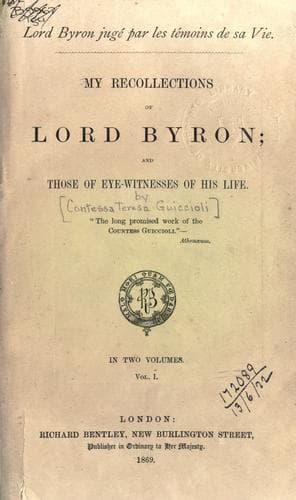
My Recollections of Lord ByronGuiccioli, Teresa, contessa di
General
My Recollections of Lord Byron
Guiccioli, Teresa, contessa di
Byron, George Gordon Byron, Baron, 1788-1824; Poets, English -- 19th century -- Biography
When the cruel criticisms of the "Edinburgh Review" condemned his first
steps in the career of literature, his chief care after the first
explosion of his own sorrow, was to allay, as far as he could, the
sensitiveness of his mother, who, not having the same motive or power to
summon up a spirit of resistance, was, of course, more helplessly alive
to this attack upon his fame, and felt it far more than, after the first
burst of indignation, he did himself.
During his first travels to the East his affairs were in a very
embarrassed state. But, nevertheless, here are the terms in which he
wrote to his mother from Constantinople:--
"If you have occasion for any pecuniary supply, pray use my funds as far
as they go, without reserve; and, lest this should not be enough, in my
next to Mr. H---- I will direct him to advance any sum you may want."
There is a degree of melancholy in the letter which he wrote to his
mother on his return to England. He had received most deplorable
accounts of his affairs when at Malta, and he applied the terms apathy
and indifference to the sentiments with which he approached his native
land. He goes on to say, however, that the word apathy is not to be
applied to his mother, as he will show; that he wishes her to be the
mistress of Newstead, and to consider him only as the visitor. He brings
her presents of all kinds, etc. "That notwithstanding this alienation,"
adds Moore, "which her own unfortunate temper produced, he should have
continued to consult her wishes, and minister to her comforts with such
unfailing thoughtfulness (as is evinced not only in the frequency of his
letters, but in the almost exclusive appropriation of Newstead to her
use), redounds in no ordinary degree to his honor."
This want of affection never existed but in the minds of some of Byron's
biographers. Lord Byron knew that his mother doted upon him, and that
she watched his growing fame with feverish anxiety.
His successes were passionately looked forward to by her. She had
collected in one volume all the articles which had appeared upon his
first poems and satires, and had written her own remarks in the margin,
which showed that she was possessed of great good sense and considerable
talent. Could, then, such a heart as Lord Byron's be ungrateful, and not
love such a mother? Mr. Galt, a biographer of Byron's, who is certainly
not to be suspected of partiality, renders him, however, full justice in
regard to his filial devotion during the life of his mother, and to the
deep distress which he felt at her death.
Public-domain text, read in full here on John Shaqi.
Reviews
Reviews
No reviews yet
Be the first to share your thoughts on this work.
Elsewhere in the archive
Join the Discussion
Join the discussion
Sign in to leave a comment or review.
Sign InorCreate an account