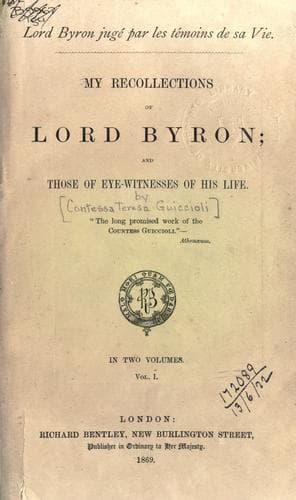
My Recollections of Lord ByronGuiccioli, Teresa, contessa di
General
My Recollections of Lord Byron
Guiccioli, Teresa, contessa di
Byron, George Gordon Byron, Baron, 1788-1824; Poets, English -- 19th century -- Biography
"In the mean time, while busily engaged in his literary projects with
Mr. Dallas, and in law affairs with his agent, he was suddenly summoned
to Newstead by the state of his mother's health. Before he reached the
Abbey she had breathed her last. The event deeply affected him.
Notwithstanding her violent temper, her affection for him had been so
fond and ardent that he undoubtedly returned it with unaffected
sincerity; and, from many casual and incidental expressions which I have
heard him employ concerning her, I am persuaded that this filial love
was not at any time even of an ordinary kind."
On the night after his arrival at the Abbey, the waiting-woman of Mrs.
Byron, in passing the door of the room where the corpse lay, heard the
sound of some one sighing heavily within, and, on entering, found his
lordship sitting in the dark beside the bed. She remonstrated, when he
burst into tears, and exclaimed, "I had but one friend in the world, and
she is gone!" This same filial devotion often inspired him with
beautiful lines, such as those in the third canto of "Childe Harold,"
when standing before the tomb of Julia Alpinula, he exclaims:
LXVI.
"And there--oh! sweet and sacred be the name!--
Julia--the daughter, the devoted--gave
Her youth to Heaven; her heart, beneath a claim
Nearest to Heaven's, broke o'er a father's grave.
Justice is sworn 'gainst tears, and hers would crave
The life she lived in; but the Judge was just,
And then she died on him she could not save.
Their tomb was simple, and without a bust,
And held within their urn one mind, one heart, one dust.
LXVII.
"But these are deeds which should not pass away,
And names that must not wither, though the earth
Forgets her empires with a just decay,
The enslavers and the enslaved, their death and birth;
The high, the mountain-majesty of worth
Should be, and shall, survivor of its woe,
And from its immortality look forth
In the sun's face, like yonder Alpine snow,
Imperishably pure beyond all things below."
As a note to the above, Byron writes:
"Julia Alpinula, a young Aventian priestess, died soon after a vain
attempt to save her father, condemned to death as a traitor by Aulus
Coecina. Her epitaph was discovered many years ago; it is thus:
"JULIA ALPINULA:
HIC JACEO.
INFELICIS PATRIS, INFELIX PROLES.
DEAE AVENTIAE SACERDOS.
EXORARE PATRIS NECEM NON POTUI:
MALE MORI IN FATIS ILLE ERAT.
VIXI ANNOS XXIII.
"I know," adds Byron, "of no human composition so affecting as this, nor
a history of deeper interest. These are the names and actions which
ought not to perish, and to which we turn with a true and healthy
tenderness."
Public-domain text, read in full here on John Shaqi.
Reviews
Reviews
No reviews yet
Be the first to share your thoughts on this work.
Elsewhere in the archive
Join the Discussion
Join the discussion
Sign in to leave a comment or review.
Sign InorCreate an account