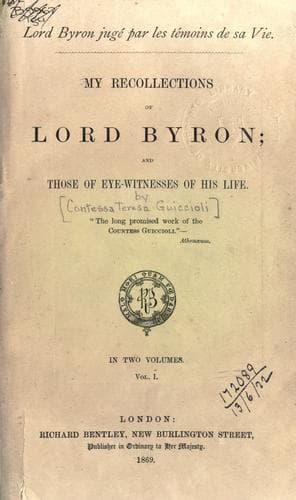
My Recollections of Lord ByronGuiccioli, Teresa, contessa di
General
My Recollections of Lord Byron
Guiccioli, Teresa, contessa di
Byron, George Gordon Byron, Baron, 1788-1824; Poets, English -- 19th century -- Biography
His father having died in 1793, when Byron was only four years of age,
he could not know him; but to show how keen were his sentiments toward
his memory, I must transcribe a note of Murray's after the following
lines in "Hours of Idleness:"--
"Stern Death forbade my orphan youth to share
The tender guidance of a father's care;
Can rank, or e'en a guardian's name supply
The love which glistens in a father's eye?"
"In all the biographies which have yet been published of Byron," remarks
Murray, "undue severity has been the light by which the character of
Byron's father has been judged. Like his son, he was unfortunately
brought up by a mother only. Admiral Byron, his father, being compelled
by his duties to live away from his family, the son was brought up in a
French military academy, which was not likely at that time to do his
morals much good. He passed from school into the Coldstream Guards,
where he was launched into every species of temptation imaginable, and
likely to present themselves to a young man of singular beauty, and heir
to a fine name, in the metropolis of England."
The unfortunate intrigue, of which so much has been said, as if it had
compromised his reputation as a man of honor, took place when he was
just of age, and he died in France at the age of thirty-five. One can
hardly understand why the biographers of Byron have insisted upon
depreciating the personal qualities of his father, apart from the
positively injurious and wicked assertions made against him in memoirs
of Lord Byron's life, and in reviews of such memoirs.
Some severe reflections of this kind having found their way into the
preface to a French translation of Byron's works, which appeared shortly
before the latter's departure for Greece, called for an expostulation by
the son himself on behalf of his father, in a letter addressed to Mr.
Coulmann, who had been charged to offer to the poet the homage of the
French literary men of the day. This letter is interesting in more than
one particular, as it re-establishes in their true light several facts
wrongly stated with regard to Byron's family, and because it is,
perhaps, the last letter which Byron wrote from Italy. It is quoted _in
extenso_ in the chapter entitled "Byron's Life in Italy."[27] I can only
repeat here the words which apply more particularly to his father:--
"The author of the essay (M. Pichot) has cruelly calumniated my father.
Far from being brutal, he was, according to the testimony of all those
who knew him, extremely amiable, and of a lively character, though
careless and dissipated. He had the reputation of being a good officer,
and had proved himself such in America. The facts themselves belie the
assertion. It is not by brutal means that a young officer seduces and
elopes with a marchioness, and then marries two heiresses in succession.
It is true that he was young, and very handsome, which is a great point.
Public-domain text, read in full here on John Shaqi.
Reviews
Reviews
No reviews yet
Be the first to share your thoughts on this work.
Elsewhere in the archive
Join the Discussion
Join the discussion
Sign in to leave a comment or review.
Sign InorCreate an account