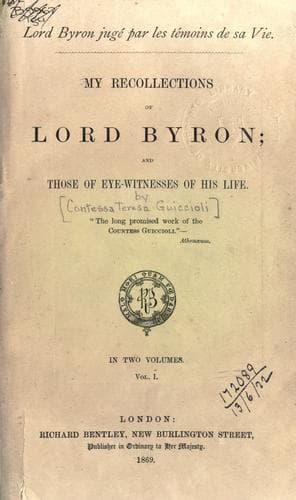
My Recollections of Lord ByronGuiccioli, Teresa, contessa di
General
My Recollections of Lord Byron
Guiccioli, Teresa, contessa di
Byron, George Gordon Byron, Baron, 1788-1824; Poets, English -- 19th century -- Biography
This quality was so strong in him, that it not only permitted him to
forget all past offenses, but even rendered him blind to any fresh
wrongs. It sufficed to have been kind to him once, to claim his
indulgence. The reader remembers that Jeffrey had been the most cruel of
the persecutors of his early poems, but that later he had shown more
impartiality. This act of justice appeared to Byron a generous act, and
one sufficient for him in return to forget all the harm done to him in
the past. We accordingly find in his memoranda of 1814:--
"It does honor to the editor (Jeffrey), because he once abused me: many
a man will retract praise; none but a high-spirited mind will revoke its
censure, or _can_ praise the man it has once attacked."
Yet Jeffrey, who was eminently a critic, gave fresh causes of
displeasure to Byron at a later period, and then it was that he forgot
the present on recalling the past.
In speaking of this Scotch critic, he considered himself quite disarmed.
When at Venice, he heard that he had been attacked about Coleridge in
the "Edinburgh Review," he wrote as follows to Murray:--
"The article in the 'Edinburgh Review' on Coleridge, I have not seen;
but whether I am attacked in it or not, or in any other of the same
journal, I shall never think ill of Mr. Jeffrey on that account, nor
forget that his conduct toward me has been certainly most handsome
during the last four or more years."[28]
And instead of complaining of this attack, he laughed at it with
Moore:--
"The 'Edinburgh Review' had attacked me.... Et tu, Jeffrey! 'there is
nothing but roguery in villainous man.' But I absolve him of all
attacks, present and future; for I think he had already pushed his
clemency in my behoof to the utmost, and I shall always think well of
him. I only wonder he did not begin before, as my domestic destruction
was a fine opening for all who wished to avail themselves of the
opportunity."[29]
His great sympathy for Walter Scott became quite enthusiastic, owing
also to a feeling of gratitude for a service rendered to him by Scott.
Shortly after his arrival in Italy, and the publication of the third
canto of "Childe Harold," public opinion in England went completely
against him, and an article appeared in the "Quarterly Review," by an
anonymous pen, in his defense. Byron was so touched by this, that he
endeavored to find out the name of its writer.
Public-domain text, read in full here on John Shaqi.
Reviews
Reviews
No reviews yet
Be the first to share your thoughts on this work.
Elsewhere in the archive
Join the Discussion
Join the discussion
Sign in to leave a comment or review.
Sign InorCreate an account