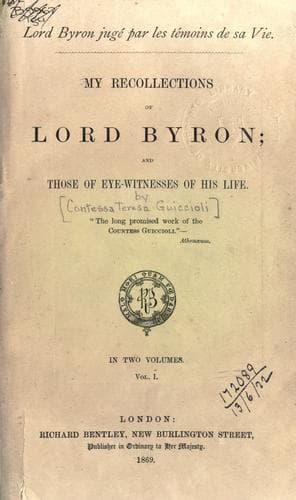
My Recollections of Lord ByronGuiccioli, Teresa, contessa di
General
My Recollections of Lord Byron
Guiccioli, Teresa, contessa di
Byron, George Gordon Byron, Baron, 1788-1824; Poets, English -- 19th century -- Biography
"I can not," he said to Murray, "express myself better than in the words
of my sister Augusta, who (speaking of it) says, 'that it is written in
a spirit of the most feeling and kind nature.' It is, however, something
more: it seems to me (as far as the subject of it may be permitted to
judge) to be very well written as a composition, and I think will do the
journal no discredit; because, even those who condemn its partiality,
must praise its generosity. The temptations to take another and a less
favorable view of the question have been so great and numerous, that
what with public opinion, politics, etc., he must be a gallant as well
as a good man, who has ventured in that place, and at this time, to
write such an article even anonymously.
"Perhaps, some day or other, you will know or tell me the writer's name.
Be assured, had the article been a harsh one, I should not have asked
it."
He afterward learnt that the article had been written by Walter Scott,
and his sympathy was so increased by his gratitude for the service
rendered, that he never after seemed happier than when he could extol
Scott's talents and kindness.
Gratitude, which often weighs upon one as a duty, so captivated his
soul, that the remembrance of the kindness done to him was wont to turn
into an affectionate devotion, which time could not change. Long after
the appearance of the article, he wrote as follows to Scott from Pisa:--
"I owe to you far more than the usual obligations for the courtesies of
literature and common friendship, for you went out of your way in 1817
to do me a service, when it required, not merely kindness, but courage
to do so; to have been mentioned by you, in such a manner, would have
been a proud memorial at any time, but at such a time, 'when all the
world and his wife,' as the proverb goes, were trying to trample upon
me, was something still more complimentary to my self-esteem. Had it
been a common criticism, however eloquent or panegyrical, I should have
felt pleased, undoubtedly, and grateful, but not to the extent which the
extraordinary good-heartedness of the whole proceeding must induce in
any mind capable of such sensations. The very tardiness of this
acknowledgment will, at least, show that I have not forgotten the
obligation; and I can assure you, that my sense of it has been out at
compound interest during the delay."
Gratitude, with him, was oftentimes a magnifying-glass which he used
when he had to appreciate certain merits. No doubt Gifford was a
judicious, clear-sighted, and impartial critic, but Byron extolled him
as an oracle of good taste, and submitted like a child to his decisions.
Public-domain text, read in full here on John Shaqi.
Reviews
Reviews
No reviews yet
Be the first to share your thoughts on this work.
Elsewhere in the archive
Join the Discussion
Join the discussion
Sign in to leave a comment or review.
Sign InorCreate an account