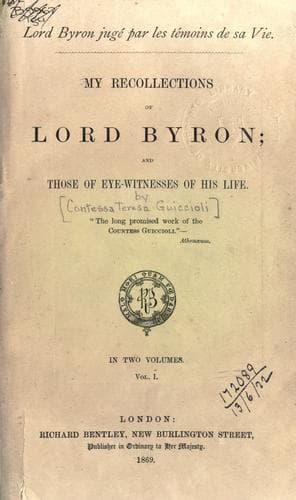
My Recollections of Lord ByronGuiccioli, Teresa, contessa di
General
My Recollections of Lord Byron
Guiccioli, Teresa, contessa di
Byron, George Gordon Byron, Baron, 1788-1824; Poets, English -- 19th century -- Biography
Gratitude levelled every social condition in his eyes, as we may see by
his correspondence with Murray, where the proud aristocrat considers his
publisher on a par with himself. Moore marvelled at this; but Moore
forgets that Murray was no ordinary publisher, and that, generous by
nature, he made to Byron on one occasion, in 1815, when the noble poet
was in great difficulties, the handsomest offers. Lord Byron refused
them; but the act was so noble, that its impression was never effaced
from Byron's mind, and modified the nature of their relations.
When he had recovered his fortune, he wrote to Murray from Ravenna:--"I
only know of three men who would have raised a finger on my behalf; and
one of those is yourself. It was in 1815, when I was not even sure of a
five-pound note. I refused your offer, but have preserved the
recollection of it, though you may have lost it."
To calculate the degree of gratitude due to a service rendered, would
have seemed ingratitude in his eyes. He could create beings who were
capable of doling it out in that way, but to apply it to himself was an
impossibility.
His predilection for the inhabitants of Epirus, of Albania, and for the
Suliotes, is known. This predilection originated in the gratitude which
he felt for the care taken of him by two Albanian servants who doted on
him, during an illness which he had at Patras at the time when he
visited that place for the first time. It was also on the Albanian coast
that he was wrecked on one occasion, and where he received that
hospitality which he has immortalized in Don Juan.
Byron's predilection for this people even overcame the effects which
their ingratitude might have produced, for it is matter of history, how
badly the barbarous Suliotes behaved to him at Missolonghi a short time
before his death; they who had been so benefited by his kindness to
them.
The memory of services done to him was not susceptible of change, and
neither time nor distance could in the least affect it. The moment he
had contracted a debt of gratitude, he believed himself obliged to pay
interest upon it all his life, even had he discharged his debt. One
single anecdote will serve to illustrate the truth of these remarks. On
the eve of his last departure from London in 1816, when the cruelty of
his enemies, powerfully seconded by the spite of Lady Byron, had
succeeded in so perverting facts as to give their calumnies the color of
truth, and to throw upon his conduct as a husband so false a light as to
hold him up to universal execration, it required great courage to
venture on his defense. Lady Jersey did it. She--who was then quite the
mistress of fashion by her beauty, her youth, her rank, her fortune,
and her irreproachable conduct--organized a fete in honor of Byron, and
invited all that was most distinguished in London to come and wish Byron
farewell.
Public-domain text, read in full here on John Shaqi.
Reviews
Reviews
No reviews yet
Be the first to share your thoughts on this work.
Elsewhere in the archive
Join the Discussion
Join the discussion
Sign in to leave a comment or review.
Sign InorCreate an account