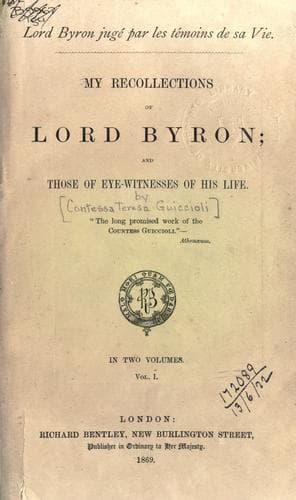
My Recollections of Lord ByronGuiccioli, Teresa, contessa di
General
My Recollections of Lord Byron
Guiccioli, Teresa, contessa di
Byron, George Gordon Byron, Baron, 1788-1824; Poets, English -- 19th century -- Biography
All those who have studied human nature agree that impulses show the
natural qualities of the soul. "Beware of your first impulses, they are
always true," said a diplomatist, the same who insisted that speech was
given us to conceal our thoughts. If such be the case, Lord Byron's
goodness of heart is palpable, for all who knew him agree in bearing
testimony to the extraordinary goodness of all his impulses. "His
lordship," says Parry, "was keenly sensitive at the recital of any case
of distress, in the first instance; and advantage being taken of this
feeling immediately, he would always relieve it when in his power. If
this passion, however, was allowed to cool, he was no longer to be
excited. This was a fault of Lord Byron's, as he frequently offered,
upon the impulse of a moment, assistance which he would not afterward
give, and therefore occasionally compromise his friends."
To multiply quotations would only be to repeat the same proof. I shall
therefore merely add that it was often the necessity of modifying the
nobility of his first impulses which made him appear inconstant and
changeable.
EFFECTS OF HAPPINESS AND MISFORTUNE UPON BYRON.
"The effect of a great success," writes some one, "is ever bad in bad
natures, but does good only to such as are really good in themselves."
As the rays of the sun soften the honey and harden the mud, so the rays
of happiness soften a good and tender heart, while they harden a base
and egotistical nature. This proof has not been wanting in Byron. His
wonderful successes, which laid at his feet the homage of nations, and
which might easily have made him vain and proud, only rendered him
better, more amiable, and brighter.
"I am happy," said Dallas, on the occasion of the great success which
greeted the publication of the first canto of "Childe Harold," "to think
that his triumph, and the attention which he has attracted, have already
produced upon him the soothing effect I had hoped. He was very lively to
day."
Moore says the same; and Galt is obliged to grant that, as Byron became
the object of public curiosity, his desire to oblige others increased.
After giving a personal proof of Byron's goodness to him, he ends by
saying:--
"His conversation was then so lively, that gayety seemed to have passed
into habit with him." It was also at that time that he wrote in his
memoranda:--"I love Ward, I love A----, I love B----," and then, as if
afraid of those numerous sympathies, he adds: "oh! shall I begin to love
the whole world?" This universal love was only the expression of the
want of his soul which had mollified under the rays of that mild sun
which is called happiness.
EFFECTS OF MISFORTUNE AND INJUSTICE UPON BYRON.
If his natural goodness had so large a field to develop itself in
happiness, it reached a degree of sublimity in misfortune.
Public-domain text, read in full here on John Shaqi.
Reviews
Reviews
No reviews yet
Be the first to share your thoughts on this work.
Elsewhere in the archive
Join the Discussion
Join the discussion
Sign in to leave a comment or review.
Sign InorCreate an account