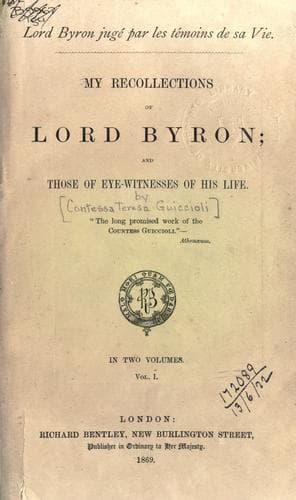
My Recollections of Lord ByronGuiccioli, Teresa, contessa di
General
My Recollections of Lord Byron
Guiccioli, Teresa, contessa di
Byron, George Gordon Byron, Baron, 1788-1824; Poets, English -- 19th century -- Biography
That Byron's short life was full of real sorrows, I have shown in
another chapter, when I had to prove their reality against those
imputations of their being imaginary made by some of his biographers. He
required a strength of mind equal to his genius and to his sensibility,
to be able to resist the numerous ills with which he was assailed,
throughout his life:--
"Have I not had to wrestle with my lot?
Have I not suffered things to be forgiven?
Have I not had my brain sear'd, my heart riven,
Hopes sapp'd, name blighted, Life's life lied away?"
Such beautiful lines speak loudly enough of the intensity of his
sufferings. Great as they were, they did not, however, produce in him
any feeling of hatred. To forgive was his only revenge; and not only did
he forgive, but, the paroxysm of passion over, there was only room in
his soul for those nobler feelings of patience, of toleration, of
resignation, and of abnegation, of which no one in London can have
formed a notion. The storms to which his soul was at times a prey only
purified it, and discovered a host of qualities which are kept back
often by the more powerful passions of youth. If he never attained that
calmness of spirit which is the gift of those who can not feel, or
perhaps of the saints, he at any rate, at the age of thirty-two, began
to feel a contempt of all worldly and frivolous matters, and came to the
resolution of forgiving most generously all offenses against him.
Shelley, who went to see him at Ravenna, wrote to his wife "that if he
had mischievous passions he seemed to have subdued them; and that he was
becoming, what he should be,--a _virtuous man_."
Mme. de Bury, in her excellent essay upon Byron, expresses herself thus:
"Had his natural goodness not been great, the events which compelled him
to leave his country, and which followed upon his departure, must have
exercised over his mind the effect of drying it up; and, in lessening
its power, would have forced him to give full vent to his passions."
Instead of producing such a result, they on the contrary purified it,
and developed in him the germs of a host of virtues. I shall not tarry
any longer, however, on this subject, as in another chapter I intend to
consider Byron's kindness of disposition from a far higher point of
view. I shall only add his own words, which prove his goodness of
character. "I can not," said he, "bear malice to any one, nor can I go
to sleep with an ill thought against any body."
ABSENCE OF ALL JEALOUS FEELINGS IN LORD BYRON.
Public-domain text, read in full here on John Shaqi.
Reviews
Reviews
No reviews yet
Be the first to share your thoughts on this work.
Elsewhere in the archive
Join the Discussion
Join the discussion
Sign in to leave a comment or review.
Sign InorCreate an account