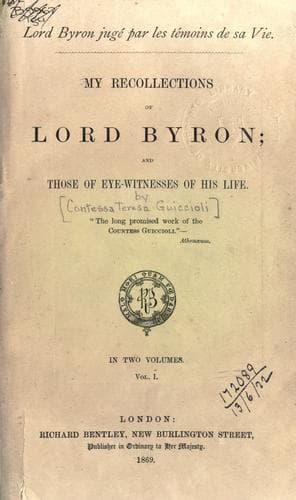
My Recollections of Lord ByronGuiccioli, Teresa, contessa di
General
My Recollections of Lord Byron
Guiccioli, Teresa, contessa di
Byron, George Gordon Byron, Baron, 1788-1824; Poets, English -- 19th century -- Biography
To know best his feelings with respect to his rivals, we must listen to
himself; and to preserve the order given in the triangle, let us begin
by Walter Scott. We read in Byron's memorandum of the 17th of September,
1813:--
"George Ellis and Murray have been talking something about Scott and me,
George _pro_ Scoto--and very right too. If they want to depose him, I
only wish they would not set me up as a competitor. Even if I had my
choice, I would rather be the Earl of Warwick than all the kings he ever
made! Jeffrey and Gifford I take to be the monarch-makers in poetry and
prose. I like Scott--and admire his works to what Mr. Braham calls
Entusymusy. All such stuff can only vex him, and do me no good."
And elsewhere: "I have not answered W. Scott's last letter, but I will.
I regret to hear from others that he has lately been unfortunate in
pecuniary involvements. He is undoubtedly the Monarch of Parnassus, and
the most English of bards."
When these expressions were written, Byron did not know Scott
personally; but notwithstanding his satire, of which he had often made a
generous retractation, he had always felt a great sympathy for Scott,
who, on the other hand, appeared to have forgotten the wound inflicted
by Byron's youthful pen, only to remember the latter's heartfelt
praises.
A few years after the publication of "English Bards" and just after that
of "Childe Harold," Byron and Sir W. Scott manifested a mutual desire to
make each other's acquaintance through the medium of Murray, who was
then travelling in Scotland. An exchange of letters full of mutual
generosity had taken place, when George IV., then regent, expressed the
wish to make Byron's acquaintance.
After speaking to him of "Childe Harold," in terms which Byron was
always proud to recall, the prince went on to speak of Walter Scott in
the most enthusiastic terms. Byron seemed almost as pleased as if the
praise had been addressed to himself, and hastened to make his
illustrious rival acquainted with the flattering words used by royalty
with regard to him.
It was only in the summer of 1815 that they became personally
acquainted. Scott was then passing through London on his way to France.
Their sympathy was mutual. Byron, who had been married seven months,
already foresaw that a storm was brewing in his domestic affairs, which
explains the mysterious melancholy, observed by Scott, upon the
countenance of his young friend. Scott's liveliness, however, always
brought about a return of Byron's spirits, and their meetings were
always very gay, "the gayest even," says Scott, "that I ever spent."
Byron's handsomeness produced a great impression upon Scott. "It is a
beauty," said he, "which causes one to reflect and to dream;" as if he
wished one to understand that he thought Byron's beauty superhuman.
Public-domain text, read in full here on John Shaqi.
Reviews
Reviews
No reviews yet
Be the first to share your thoughts on this work.
Elsewhere in the archive
Join the Discussion
Join the discussion
Sign in to leave a comment or review.
Sign InorCreate an account