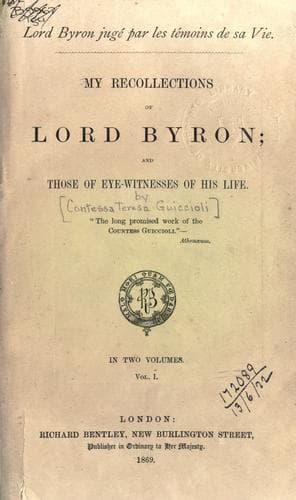
My Recollections of Lord ByronGuiccioli, Teresa, contessa di
General
My Recollections of Lord Byron
Guiccioli, Teresa, contessa di
Byron, George Gordon Byron, Baron, 1788-1824; Poets, English -- 19th century -- Biography
"Report had prepared me to meet a man of peculiar habits and a quick
temper, and I had some doubt whether we were likely to suit each other
in society. I was most agreeably disappointed in this respect. I found
Lord Byron in the highest degree courteous, and even kind.
"Like the old heroes in Homer, we exchanged gifts: I gave Byron a
beautiful dagger mounted with gold, which had been the property of the
redoubted Elfi Bey. But I was to play the part of Diomed in the Iliad,
for Byron sent me, some time after, a large sepulchral vase of silver.
It was full of dead men's bones, and had inscriptions on the sides of
the base. One ran thus:--"The bones contained in this urn were found in
certain ancient sepulchres within the land walls of Athens in the month
of February, 1811. The other face bears the lines of Juvenal--
'Expende quot libras in duce summo invenies.
Mors sola fatetur quantula hominum corpuscula.'
"A letter," adds W. Scott, "accompanied this vase, which was more
valuable to me than the gift itself, from the kindness with which the
donor expressed himself toward me. I left it, naturally, in the urn with
the bones, but it is now missing. As the theft was not of a nature to be
practiced by a mere domestic, I am compelled to suspect the
inhospitality of some individual of higher station,--most gratuitously
exercised certainly, since, after what I have here said, no one will
probably choose to boast of possessing this literary curiosity."
Their mutual sympathy increased upon improved acquaintance with one
another. When at Venice Byron was informed that Scott was ill, he said
that he would not for all the world have him ill. "I suppose it is from
sympathy that I have suffered from fever at the same time." At Ravenna a
little later, on the 12th of January, 1821, he wrote down in his
memoranda:--
"Scott is certainly the most wonderful writer of the day. His novels are
a new literature in themselves, and his poetry as good as any, if not
better (only on an erroneous system), and only ceased to be so popular,
because the vulgar learned were tired of hearing Aristides called the
Just, and Scott the Best, and ostracized them.
"I like him, too, for his manliness of character, for the extreme
pleasantness of his conversation, and his good-nature toward myself
personally. May he prosper! for he deserves it.
"I know no reading to which I fall with such alacrity as a work of W.
Scott's. I shall give the seal with his bust on it to Mlle. la Comtesse
Guiccioli this evening, who will be curious to have the effigies of a
man so celebrated."
He did take the seal to the Countess Guiccioli, and she said that
Byron's expressions about Scott were always most affectionate. "How I
wish you knew him!" he often repeated.
Public-domain text, read in full here on John Shaqi.
Reviews
Reviews
No reviews yet
Be the first to share your thoughts on this work.
Elsewhere in the archive
Join the Discussion
Join the discussion
Sign in to leave a comment or review.
Sign InorCreate an account