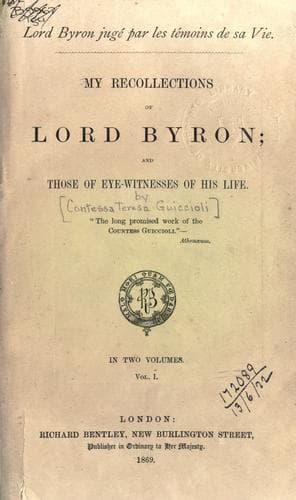
My Recollections of Lord ByronGuiccioli, Teresa, contessa di
General
My Recollections of Lord Byron
Guiccioli, Teresa, contessa di
Byron, George Gordon Byron, Baron, 1788-1824; Poets, English -- 19th century -- Biography
"There is one part of your observations in the pamphlet, which I shall
venture to remark upon: it regards Walter Scott. You say that 'his
character is little worthy of enthusiasm,' at the same time that you
mention his productions in the manner they deserve. I have known Walter
Scott long and well, and in occasional situations which call forth the
real character, and I can assure you that his character _is_ worthy of
admiration; that of all men, he is the most open, the most honorable,
the most amiable," etc.
BYRON."
Even at Missolonghi, where certainly literary thoughts were little in
harmony with his occupations, Byron found occasion to speak of his
sentiments as regards Scott, since even the simple and anti-poetic Parry
tells us, in his interesting narrative of "The Last Days of Lord Byron,"
of the admiration and affection with which Byron always spoke of Walter
Scott. "He never wearied of his praise of 'Waverley,' and continually
quoted passages from it."
May we be allowed to observe, in conclusion, that such a generous desire
on the part of Byron constantly to put forward the merits of Scott
deserved from the latter a warmer acknowledgment. The homage paid to his
memory by Scott came late, and is cold. Be it from a Tory or Protestant
spirit, Scott in his eulogy of Lord Byron did not disclaim openly the
calumnies uttered against the great poet's fame, but almost sided with
his hypocritical apologists, by assuming a kind of tone of indulgence in
speaking of him.
ROGERS.
Rogers comes next in the triangular order.
Byron's esteem for Rogers was such, that not only did he spare him in
his famous satire, but even addressed him a real compliment in the
lines:--
"And thou, melodious Rogers! rise at last,
Recall the pleasing memory of the past;
Arise! let blest remembrance still inspire,
And strike to wonted tones thy hallow'd lyre;
Restore Apollo to his vacant throne,
Assert thy country's honor and thine own."
He equally declared that, after the "Essay on Man" of Pope, the
"Pleasures of Memory" constituted the finest English didactic poem. This
opinion he maintained always.
"I have read again the 'Pleasures of Memory,'" he wrote in September,
1813. "The elegance of this poem is quite marvellous. Not a vulgar line
throughout the whole book."
About the same time he read, in the "Edinburgh Review," a eulogy of
Rogers. "He is placed very high," he exclaimed, "but not higher than he
has a right to be. There is a summary review of every body. Moore and I
included: we were both--he justly--praised; but both very justly ranked
under Rogers.
At another time he wrote in his memoranda:
Public-domain text, read in full here on John Shaqi.
Reviews
Reviews
No reviews yet
Be the first to share your thoughts on this work.
Elsewhere in the archive
Join the Discussion
Join the discussion
Sign in to leave a comment or review.
Sign InorCreate an account