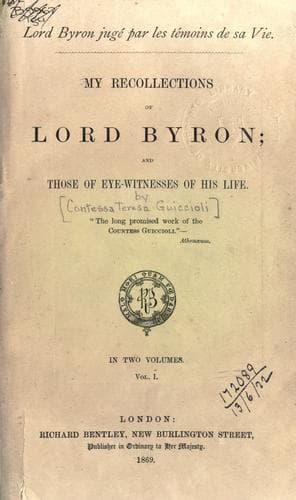
My Recollections of Lord ByronGuiccioli, Teresa, contessa di
General
My Recollections of Lord Byron
Guiccioli, Teresa, contessa di
Byron, George Gordon Byron, Baron, 1788-1824; Poets, English -- 19th century -- Biography
He used to say that it was not the poetry of "Child Harold," but Scott's
own superior prose that had done his poetry harm, and that if ever the
public could by chance get tired of his novels, Scott might write in
verse with equal success. He insisted that Scott had a dramatic talent,
"talent," he said, "which people are loth to grant me." He said that the
success of Scott's novels was not in the least due to the anonymous
character he had adopted, and that he could not understand why he would
not sign his name to works of such merit. He likewise asserted that of
all the authors of his period, Scott was the least jealous. "He is too
sure of his fame to fear any rivals, nor does he think of good works as
Tuscans do of fever; that there is only a certain amount of it in the
world, and that in communicating it to others, one gets rid of it."
"I never travel without taking Scott's novels with me," said Byron to
Medwin, at Pisa; "it is a real library, a literary treasure; I can read
them yearly with renewed pleasure."
A few days before his departure for Greece, he learned that M. Stendhall
had published an article upon Racine and Shakspeare, wherein there were
some unfavorable remarks about Walter Scott.
Notwithstanding his occupations preparatory to departure, he found time
to write to Stendhall, and tell him how much he felt the injustice of
these remarks, and to request that they should be rectified.
This letter of Byron's to M. Beyle will no doubt be read with universal
admiration, as it points out most prominently all the goodness of his
character:--
"SIR,--Now that I know to whom I am indebted for a very flattering
mention in the 'Rome, Naples, and Florence, in 1817,' by Monsieur
Stendhall, it is fit that I should return my thanks (however undesired
or undesirable) to Monsieur Beyle, with whom I had the honor of being
acquainted at Milan in 1816.[30] You only did me too much honor in what
you were pleased to say in that work, but it has hardly given
me less pleasure than the praise itself, to become at length aware
(which I have done by mere accident) that I am indebted for it to one of
whose good opinion I was really ambitious. So many changes have taken
place since that period in the Milan circle, that I hardly dare recur to
it--some dead, some banished, and some in the Austrian dungeons. Poor
Pelico! I trust that in his iron solitude his muse is consoling him in
some measure, one day to delight us again, when both she and her poet
are restored to freedom.
Public-domain text, read in full here on John Shaqi.
Reviews
Reviews
No reviews yet
Be the first to share your thoughts on this work.
Elsewhere in the archive
Join the Discussion
Join the discussion
Sign in to leave a comment or review.
Sign InorCreate an account