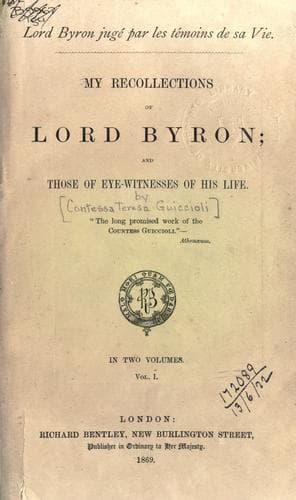
My Recollections of Lord ByronGuiccioli, Teresa, contessa di
General
My Recollections of Lord Byron
Guiccioli, Teresa, contessa di
Byron, George Gordon Byron, Baron, 1788-1824; Poets, English -- 19th century -- Biography
"I have read 'Lalla Rookh.' ... I am very glad to hear of his
popularity, for Moore is a very noble fellow, in all respects, and will
enjoy it without any of the bad feelings which success, good or evil,
sometimes engenders in the men of rhyme."
He wrote to Moore from Ravenna, in a sort of jest,--"I am not quite sure
that I shall allow the Miss Byrons to read 'Lalla Rookh,'--in the first
place, on account of this sad _passion_, and in the second, that they
mayn't discover that there was a better poet than Papa."[32]
To end these quotations, let us add that, shortly before his death, he
said to Medwin:--"Moore is one of the small number of writers, who will
survive the century which has appreciated his worth. The Irish Melodies
will go to posterity with their music, and the poems and the music will
last as long as Ireland, or music or poetry."
CAMPBELL.
Campbell, the author of "Pleasures of Hope," and who stands fourth in
the triangle, was spared, with Rogers, in the famous satire--
"Come forth, oh! Campbell, give thy talents scope:
Who dare aspire, if thou must cease to hope?"
This homage was strengthened by a note, in which Byron called the
"Pleasures of Hope" one of the finest didactic poems in the English
language.
Byron's relations with Campbell were never as intimate as with other
poets. Not only because circumstances prevented it, but also in
consequence of a fault in Campbell's character, which lessened the
sympathy raised by the admiration of his talent and of his worth. This
fault consisted in an _excessive_ opinion of himself, which prevented
his being just toward his rivals, and bearing patiently with their
successes, or the criticisms of his own work.
Coleridge at this time was giving lectures upon poetry, in which he
taught a new system of poetry.
"He attacks," says Lord Byron, "the 'Pleasures of Hope,' and all other
pleasure whatever.... Campbell will be desperately annoyed. I never saw
a man (and of him I have seen very little) so sensitive. What a happy
temperament! I am sorry for it; what can _he_ fear from criticism?"
Lord Byron had just published the "Bride of Abydos," when he wrote in
his journal, "Campbell last night seemed a little nettled at something
or other--I know not what. We were standing in the ante-saloon, when
Lord H---- brought out of the other room a vessel of some composition
similar to that which is used in Catholic churches for burning incense,
and seeing us, he exclaimed, 'Here is some incense for you.' Campbell
answered, 'Carry it to Lord Byron; he is used to it.'
"Now this comes of 'bearing no brother near the throne.' I who have no
throne am at perfect peace with all the poetical fraternity."
But if this weakness of Campbell lessened Byron's sympathy for him, or
rather interfered with his intimacy, it never altered his just
appreciation of his merits, or made him less generous to him.
Public-domain text, read in full here on John Shaqi.
Reviews
Reviews
No reviews yet
Be the first to share your thoughts on this work.
Elsewhere in the archive
Join the Discussion
Join the discussion
Sign in to leave a comment or review.
Sign InorCreate an account