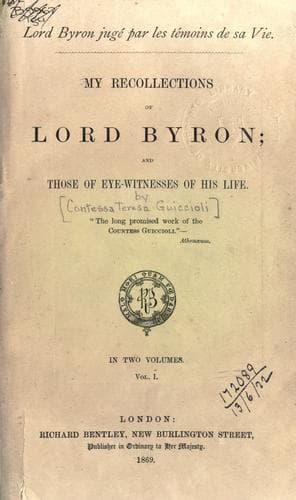
My Recollections of Lord ByronGuiccioli, Teresa, contessa di
General
My Recollections of Lord Byron
Guiccioli, Teresa, contessa di
Byron, George Gordon Byron, Baron, 1788-1824; Poets, English -- 19th century -- Biography
"By-the-by," writes Byron to Moore, "Campbell has a printed poem which
is not yet published, the scene of which is laid in Germany. It is
perfectly magnificent, and equal to himself. I wonder why he does not
publish it."
Later on, in Italy, when in his reply to Blackwood, Byron criticises
modern poetry, and gives, without sparing any body, not even himself,
his unbiased opinion about the poets of the day, he says: "We are all on
a false track, except Rogers, Campbell, and Crabbe."
And in his memoranda in 1821, at Ravenna, we find the following
passage:----
"Read Campbell's 'Poets' ... justly celebrated. His defense of Pope is
glorious. To be sure, it is his own cause too--but no matter, it is very
good, and does him great credit.... If any thing could add to my esteem
of this gentleman poet, it would be his classical defense of Pope
against the cant of the present day."
On the fifth line of the triangle come the names of Southey, Wordsworth,
and Coleridge, commonly called the "Lakers," because they had resided
near the Lakes of Cumberland and Westmoreland. He was certainly bitter
against these in his satire; but owing simply to their efforts to upset
the school of Pope, of which he had made a deep study, and to their
endeavors to start an aesthetical school, which he strenuously opposed.
As, however, in blaming, he allowed his passion at times to master his
opinions and judgments of their merits, he generously made amends and
owned his error some years later. He kept to his own notions of poetry
and art, but nobly recognized the talent of the Lakers, knowing,
however, very well that he would never obtain from them a reciprocity of
good feeling.
SOUTHEY.
"Yesterday, at Holland House, I was introduced to Southey,--the
best-looking bard I have seen for some time. To have that poet's head
and shoulders, I would almost have written his 'Sapphics.' He is
certainly a prepossessing person to look on, and a man of talent, and
all that--and--there is his eulogy."
"Southey I have not seen much of. His appearance is epic; and he is the
only existing entire man of letters. His manners are mild, but not those
of a man of the world, and his talents of the first order. His prose is
perfect. Of his poetry there are various opinions: there is, perhaps,
too much of it for the present generation--posterity will probably
select. He has passages equal to any thing. At present he has a party,
but no public--except for his prose writings. The 'Life of Nelson' is
beautiful."
WORDSWORTH.
Underneath some lines of his satire upon Wordsworth, Byron in 1816 wrote
in Switzerland the word "unjust!"
He often praised Wordsworth, even at times when the latter had, for
reasons which I will mention hereafter, lost all claims to Byron's
indulgence. Even in his poem of the "Island," written shortly before his
departure for Greece, where he was to die, Byron found means of
inserting a passage from Wordsworth's poem, which he considered
exquisite.
COLERIDGE.
Public-domain text, read in full here on John Shaqi.
Reviews
Reviews
No reviews yet
Be the first to share your thoughts on this work.
Elsewhere in the archive
Join the Discussion
Join the discussion
Sign in to leave a comment or review.
Sign InorCreate an account