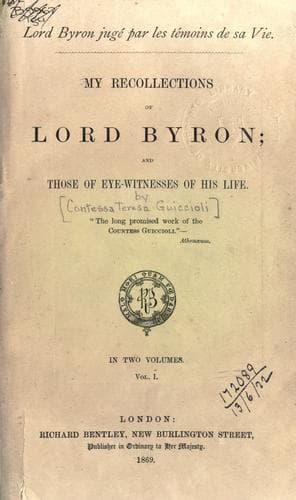
My Recollections of Lord ByronGuiccioli, Teresa, contessa di
General
My Recollections of Lord Byron
Guiccioli, Teresa, contessa di
Byron, George Gordon Byron, Baron, 1788-1824; Poets, English -- 19th century -- Biography
At the same time Byron paid so noble a tribute to Coleridge's talent,
and to his poem of "Christabel," by inserting a note on the subject in
his preface to the "Siege of Corinth," that Coleridge's editor took this
note as the epigraph.
"Christabel!--I won't have any one," he said, "sneer at 'Christabel;' it
is a fine wild poem."
In 1816 he wrote from Venice to Moore:--
"I hear that the E.R. has cut up Coleridge's 'Christabel,' and declared
against me for praising it. I praised it, firstly, because I thought
well of it; secondly, because Coleridge was in great distress, and after
doing what little I could for him in essentials, I thought that the
public avowal of my good opinion might help him further, at least with
the booksellers. I am very sorry that J---- has attacked him, because,
poor fellow, it will hurt him in mind and pocket. As for me, he's
welcome--I shall never think less of Jeffrey for any thing he may say
against me or mine in future."
At Genoa he declared, in a memorandum, that Crabbe and Coleridge were
pre-eminent in point of power and talent.
At Pisa he blamed those who refused to see in "Christabel" a work of
rare merit, notwithstanding the knowledge which he had of Coleridge's
ingratitude to him; and refused to believe that W. Scott did not admire
the poem, "for we all owe Coleridge a great deal," said he, "and even
Scott himself."
And Medwin adds: "Lord Byron thinks Coleridge's poem very fine. He
paraphrased and imitated one passage. He considers the idea excellent,
and enters into it."
And speaking of Coleridge's psychological poem, he said: "What perfect
harmony! 'Kubla Khan' delights me."
SHELLEY.
If Shelley did not find a place in the triangle, it is only because he
was not yet known, except by the eccentricities of his conduct as a boy.
But so soon as Byron was able to appreciate his genius, he lavished
praises upon the poet and the man, while he blamed his metaphysics.
In all his letters we find proofs of his affectionate regard for
Shelley; and during his last days in Greece, he said to
Finlay,--"Shelley was really a most extraordinary genius; but those who
know him only from his works, know but half his merits: it was from his
thoughts and his conversation poor Shelley ought to be judged. He was
romance itself in his manners and his style of thinking."
"You were all mistaken," he wrote from Pisa to Murray, "about Shelley,
who was, without exception, the best and least selfish man I ever knew."
And when he learned his death, he wrote to Moore:--"There is thus
another man gone, about whom the world was ill-naturedly, and
ignorantly, and brutally mistaken. It will, perhaps, do him justice now,
when he can be no better for it."
Public-domain text, read in full here on John Shaqi.
Reviews
Reviews
No reviews yet
Be the first to share your thoughts on this work.
Elsewhere in the archive
Join the Discussion
Join the discussion
Sign in to leave a comment or review.
Sign InorCreate an account