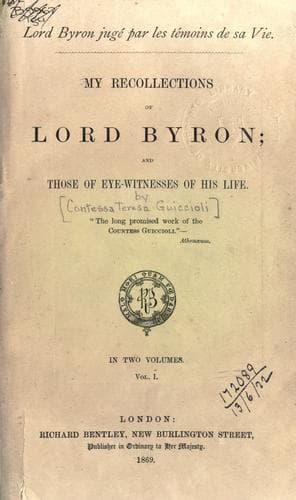
My Recollections of Lord ByronGuiccioli, Teresa, contessa di
General
My Recollections of Lord Byron
Guiccioli, Teresa, contessa di
Byron, George Gordon Byron, Baron, 1788-1824; Poets, English -- 19th century -- Biography
Among the three Lakers, Coleridge was the one to whom he showed the most
generous feeling. He was poor, and lived by his pen. Lord Byron, putting
this consideration above all others, wished to assist at his readings,
and praised them warmly. Coleridge having asked him on one occasion to
interest himself with the director of Drury-lane Theatre (on the
committee of which Byron then stood) the latter did his best to gratify
the wishes of Coleridge, and wrote him the most flattering letter,
blaming the satire which had been the effect of a youthful ebullition of
feeling:--
"P.S.--You mention my 'satire,' lampoon, or whatever you or others
please to call it. I can only say that it was written when I was very
young and very angry, and has been a thorn in my side ever since; more
particularly as almost all the persons animadverted upon became
subsequently my acquaintances, and some of them my friends, which is
'heaping fire upon an enemy's head,' and forgiving me too readily to
permit me to forgive myself. The part applied to you is pert, and
petulant, and shallow enough; but, although I have long done every thing
in my power to suppress the circulation of the whole thing, I shall
always regret the wantonness or generality of many of its attacks. If
Coleridge writes his promised tragedy, Drury Lane will be set up."
Though harassed with pecuniary difficulties of all kinds, Byron
contrived to help Coleridge, who he had heard was in the greatest
distress.
He wrote to Moore:--"By the way, if poor Coleridge--who is a man of
wonderful talent, and in distress, and about to publish two volumes of
poesy and biography, and who has been worse used by the critics than
ever we were--will you, if he comes out, promise me to review him
favorably in the E.R.? Praise him I think you must; but will you also
praise him well,--of all things the most difficult? It will be the
making of him.
"This must be a secret between you and me, as Jeffrey might not like
such a project: nor, indeed, might he himself like it. But I do think he
only wants a pioneer and a spark or two to explode most gloriously."
He sent Murray a MS. tragedy of Coleridge, begging him to read it and to
publish it:----
"When you have been enabled to form an opinion on Mr. Coleridge's MS.,
you will oblige me by returning it, as, in fact, I have no authority to
let it out of my hands. I think most highly of it, and feel anxious that
you should be the publisher; but if you are not, I do not despair of
finding those who will."
As the reader knows, Byron, while in England, always gave away the
produce of his poems. To Coleridge he destined part of the sum offered
to him by Murray for "Parisina" and the "Siege of Corinth." Some
difficulty, however, having arisen, because Murray refused to pay the
100 guineas to any other than Byron himself, he borrowed it himself to
give it to Coleridge.
Public-domain text, read in full here on John Shaqi.
Reviews
Reviews
No reviews yet
Be the first to share your thoughts on this work.
Elsewhere in the archive
Join the Discussion
Join the discussion
Sign in to leave a comment or review.
Sign InorCreate an account