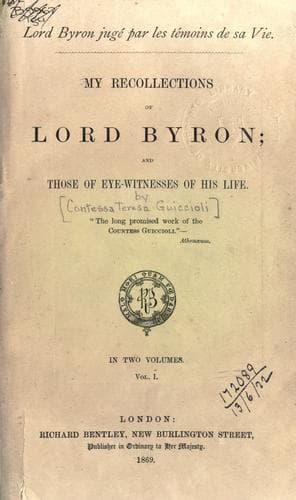
My Recollections of Lord ByronGuiccioli, Teresa, contessa di
General
My Recollections of Lord Byron
Guiccioli, Teresa, contessa di
Byron, George Gordon Byron, Baron, 1788-1824; Poets, English -- 19th century -- Biography
His admiration, therefore, was entirely centred in classical works. But
has not Shakspeare a little disregarded the eternal laws of the
beautiful observed by Homer, Pindar, and a host of other poets, ancient
and modern?
If Byron, then, did not see in Shakspeare all that perfection which an
aesthetical school just sprung from the North attributed to him, was he
to be blamed? Has he, on this account, disregarded the great merits of
that glorious mind? Even had Byron seen in Shakspeare the founder of a
dramatic school, rather than a genius more powerful than orderly, who
acted against his will upon certain principles, and who scrutinized the
human heart to an almost supernatural depth, was he interdicted from
finding fault with that school?
Does Shakspeare so economize both time and mind, as to make the action
of his dramas continuous, without fatiguing the mind or weakening the
dramatic effect? Are not the unities and the proportions disregarded in
his plays? What necessity is there at times to put one piece into
another? Are not his discussions and monologues too long? Does not his
own exuberant genius become a fatigue to himself and to his readers? Are
not, perhaps, his characters too real? and do they not often degenerate,
without motive, from the sublime into the ridiculous? Would Hamlet have
appeared less interesting or less mad had he not spoken indelicate and
cruel words to Ophelia? Would Laertes have seemed less grieved on
hearing of the death of his sister had he not made so unnecessary a play
on the words?
Was not Byron, therefore, right when he said, with Pope, that Shakspeare
was "the worst of models?" And could he possibly be called jealous,
because he added that, "notwithstanding his defects, Shakspeare was
still the most extraordinary of men of genius?"
This opinion of Byron was decidedly serious, though his opinions did not
always partake of that character. His humor was rather French: he liked
to laugh, to joke, to mystify, and astonish people who wished to
understand him. He used, then, to employ a particular measure in his
praise and his condemnation.
"On one occasion at Missolonghi, and shortly before his death," says
Colonel Stanhope, "the drama was mentioned in conversation, and Byron at
once attacked Shakspeare by defending the unities. A gentleman present,
on hearing his anti-Shakspearean opinions rushed out of the room, and
afterward entered his protest most earnestly against such doctrines.
Lord Byron was quite delighted with this, and redoubled the severity of
his criticism.
"He said once, when we were alone,--'I like to astonish Englishmen; they
come abroad full of Shakspeare, and contempt for the dramatic literature
of other nations. They think it blasphemy to find a fault in his
writings, which are full of them. People talk of my writings, and yet
read the sonnets to Master Hughes.'
Public-domain text, read in full here on John Shaqi.
Reviews
Reviews
No reviews yet
Be the first to share your thoughts on this work.
Elsewhere in the archive
Join the Discussion
Join the discussion
Sign in to leave a comment or review.
Sign InorCreate an account