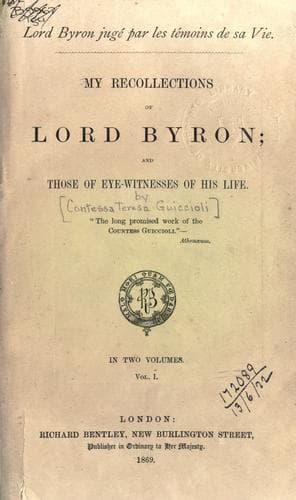
My Recollections of Lord ByronGuiccioli, Teresa, contessa di
General
My Recollections of Lord Byron
Guiccioli, Teresa, contessa di
Byron, George Gordon Byron, Baron, 1788-1824; Poets, English -- 19th century -- Biography
"And yet," continues Finlay, "he continually had the most melodious
lines of Shakspeare in his mouth, as examples of blank verse."
The jealousy of Shakspeare attributed to Byron is, however, nothing when
compared to the ridiculous assertion, that he was jealous of Keats,
simply because he had repeated in joke what the papers and Shelley
himself, a friend of Keats, had said, namely, "that the young poet had
been killed by a criticism of the 'Quarterly.'"
But since a French critic, M. Philarete Chasles, has made the same
accusation, we must pause and consider it.
At the time when Byron was more than ever penetrated with the perfection
of Pope, and opposed to the romantic school,--at the time when he
himself wrote his dramas according to all classical rules,--he received
at Ravenna the poems of a young disciple of the Lakists, who united in
himself all their exaggerated faults. This young man had the
audacity--(which was almost unpardonable in the eyes of Byron)--to
despise Pope, and to constitute himself at nineteen a lawgiver of
poetical rules in England.
Such ridiculous pride, added to the contempt shown to his idol, incensed
Byron and prevented his showing Keats the same indulgence he had shown
Maturin and Blackett. He spoke severely of Keats in his famous reply to
"Blackwood's Magazine," and to his Cambridge friends--followers of the
good old traditions. He quoted some lines of Keats, and remarked that
"they were taken from the book of a young man who was learning how to
write in verse, but who began by teaching others the art of poetry."
Then, after a long quotation, he adds--"What precedes will show the
ideas and principles professed by the regenerators of the English lyre
in regard to the man who most of any contributed to its harmony, and the
progress visible in their innovation."
Let us not forget to add that he styled Keats "the tadpole of the
Lakists."
But the following year, when he heard that Keats had died at Rome, the
victim of his inordinate self-love, and unable to be consoled for the
criticism directed against his poetry, he wrote the following heartfelt,
and, as it were, repentant words to Shelley:--
"I am very sorry to hear what you say of Keats--is it _actually_ true? I
did not think criticism had been so killing. Though I differ from you
essentially in your estimate of his performances, I so much abhor all
unnecessary pain, that I would rather he had been seated on the highest
peak of Parnassus than have perished in such a manner. Poor fellow!
though, with such inordinate self-love, he would probably have not been
very happy.... Had I known that Keats was dead, or that he was 'alive,'
and so 'sensitive,' I should have omitted some remarks upon his poetry,
to which I was provoked by his attack upon Pope, and my disapprobation
of his own style of writing."
To Murray he wrote the same day:--
Public-domain text, read in full here on John Shaqi.
Reviews
Reviews
No reviews yet
Be the first to share your thoughts on this work.
Elsewhere in the archive
Join the Discussion
Join the discussion
Sign in to leave a comment or review.
Sign InorCreate an account