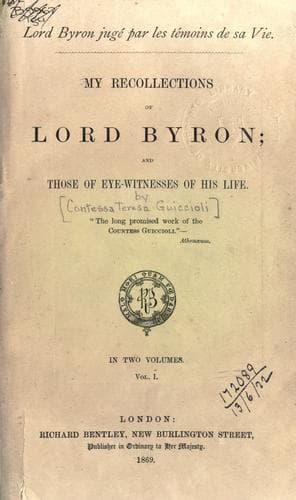
My Recollections of Lord ByronGuiccioli, Teresa, contessa di
General
My Recollections of Lord Byron
Guiccioli, Teresa, contessa di
Byron, George Gordon Byron, Baron, 1788-1824; Poets, English -- 19th century -- Biography
On one occasion, as Shelley and Medwin were laughing at some of
Wordsworth's last poems, which disgusted them, not only from the
subservient spirit to Toryism which pervaded them, but also excited
their laughter from their absurdity, Byron, in whose house they were,
said to them, "It is satisfactory to see that a man who becomes
mercenary, and traffics upon the independence of his character, loses at
the same time his talent as a poet."
Byron had such a notion of political consistency, that he ceased having
any regard for those who failed in this respect.
"I was at dinner," says Stendhall, "at the Marquis of Breno's at Milan,
in 1816, with Byron and the celebrated poet Monti, the author of
'Basvilliana.' The conversation fell upon poetry, and the question was
asked which were the twelve most beautiful lines written in a century,
either in English, in Italian, or in French. The Italians present agreed
in declaring that Monti's first twelve lines in the 'Mascheroniana' were
the finest Italian lines written for a century. Monti recited them. I
observed Byron. He was in raptures. That kind of haughty look which a
man often puts on when he has to get rid of an inopportune question, and
which rather took away from the beauty of his magnificent countenance,
suddenly disappeared to make way for an expression of happiness. The
whole of the first canto to the 'Mascheroniana,' which Conti was made to
recite, enchanted all hearers, and caused the liveliest pleasure to the
author of 'Childe Harold.' Never shall I forget the sublime expression
of his countenance: it was the peaceful look of power united with
genius."
He learned, later, that Monti was a man inconsistent in his politics,
and that on the sole impulse of his passions he had passed from one
party to another, and had called from the pen of another poet the remark
that he justified Dante's saying,--
"Il verso si non l' animo costante."
Byron's sympathy for Monti ceased from that time, and he even called him
the "Giuda del Parnaso," whereas his esteem and sympathy for Silvio
Pellico, for Manzoni, and for many other Italians, remained perfectly
unshaken.
His sense of justice extended to all nationalities. He was a
cosmopolite, and, provided the elements essential to claim his
admiration existed both in the man's work, and in his character, no
personal consideration ever came in the way of his bestowing
praise,--the most pleasing duty that could befall him. The great minds
of antiquity, those of the middle ages--especially the Italians,--all
the modern great men, of whatever nation, were all for him of one
country, the country of great intellects, and the degree of his sympathy
for each was calculated upon the degree of their merit.
We know how ably he defended Dante, the greatest of Italian poets; how
ably he translated "Francesca da Rimini," and how he exposed the error
of those who did not find that Dante was not sufficiently pathetic.
Public-domain text, read in full here on John Shaqi.
Reviews
Reviews
No reviews yet
Be the first to share your thoughts on this work.
Elsewhere in the archive
Join the Discussion
Join the discussion
Sign in to leave a comment or review.
Sign InorCreate an account