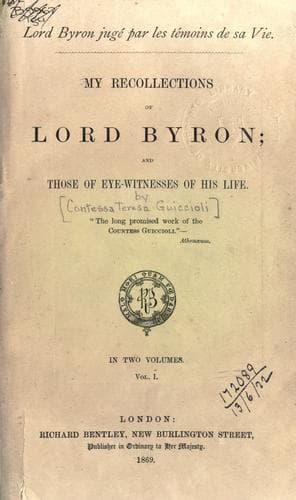
My Recollections of Lord ByronGuiccioli, Teresa, contessa di
General
My Recollections of Lord Byron
Guiccioli, Teresa, contessa di
Byron, George Gordon Byron, Baron, 1788-1824; Poets, English -- 19th century -- Biography
Byron, on the other hand, had never found these qualities in the
Lakists, and especially in the head of their school, whose whole life,
on the contrary, bore the marks of quite opposite characteristics. Since
Southey's dream of a life of intimacy with other poets of his school,
such as Wordsworth and Coleridge, in some blissful remote spot from
which they would publish their works in common, and where they would
live with their wives and children in community of interests, some
change had taken place; for Southey had so far deviated from his purpose
as to become Laureate, to write for himself, and to profess ultra-Tory
principles, the ultimate objects of which could not but be palpable.
All this called for Byron's contempt. To this contempt, however, he gave
no expression, for fear of wounding without reason, until that reason
did arise by the Laureate's unforgiving spirit. "The Laureate," says
Byron, "is not one of those who can forgive." Incapable of forgetting
that Byron's genius had obscured his own reputation, Southey hated Byron
with an intensity, such as to make him look out for opportunities of
doing him an injury. This opportunity Southey found in Byron's departure
for the Continent, subsequently to the unfortunate result of his
marriage; and not only did he join in all the calumnies which were set
forth against him in England, but actually followed him to Switzerland,
there to invent new ones, in the hope of crushing his reputation and
ruining the fame of the poet by the depreciation of the man.
Lord Byron for some time was ignorant of the Laureate's baseness, for
oftentimes friends deem it prudent to hide the truth which it would
perhaps be better to make known. But when he came to know of them, his
whole soul revolted, as naturally must be the case with a man of honor,
and in "Don Juan" he came down upon Southey with a double-edged sword,
throwing ridicule upon the author's writings, and odium upon his conduct
as a calumniator.
This revenge was well deserved. It was not only natural but just, and
even necessary, for it was requisite to show up the man, to judge of the
value to be attached to his calumnies; and later, when he called him
out, he did what honor required of him.
We have seen elsewhere how far the Laureate's conduct justified Byron's
retaliation. It is enough, therefore, that I should have shown here that
Byron's anger was rather the result of Southey's envy than his own, and
that his sarcasms were due entirely to the disgust which he felt for
such dishonorable proceedings.
From that time his language, when speaking of Wordsworth and Coleridge,
always reflected the same disgust. Both had made themselves the echoes
of Southey, and both had been inconstant from interested motives, and
had solicited favors from the party in power, which they had abused in
their writings. "They have each a price," said Byron at Pisa.
Public-domain text, read in full here on John Shaqi.
Reviews
Reviews
No reviews yet
Be the first to share your thoughts on this work.
Elsewhere in the archive
Join the Discussion
Join the discussion
Sign in to leave a comment or review.
Sign InorCreate an account