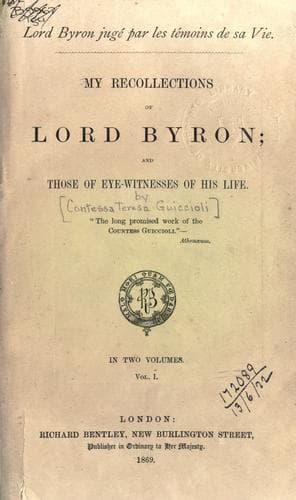
My Recollections of Lord ByronGuiccioli, Teresa, contessa di
General
My Recollections of Lord Byron
Guiccioli, Teresa, contessa di
Byron, George Gordon Byron, Baron, 1788-1824; Poets, English -- 19th century -- Biography
To Goethe also he wished to dedicate "Sardanapalus." "I mean," said he,
at Pisa, "to dedicate 'Werner' to Goethe. I look upon him as the
greatest genius that the age has produced. I desired Murray to inscribe
his name to a former work; but he said my letter containing the order
came too late. It would have been more worthy of him than this. I have a
great curiosity about every thing relating to Goethe, and please myself
with thinking there is some analogy between our characters and writings.
So much interest do I take in him, that I offered to give L100 to any
person who would translate his memoirs for my own reading. Shelley has
sometimes explained part of them to me. He seems to be very
superstitious, and is a believer in astrology, or rather was, for he was
very young when he wrote the first part of his 'Life.' I would give the
world to read 'Faust' in the original. I have been urging Shelley to
translate it." In comparing 'Cain' to 'Faust,' he said, "'Faust' itself
is not so fine a subject as 'Cain,' which is a grand mystery. The mark
that was put upon Cain is a sublime and shadowy act; Goethe would have
made more of it than I have done."
Not being able to dedicate "Sardanapalus" to him, he dedicated "Werner"
"to the illustrious Goethe, by one of his humblest admirers."
All these tokens of sympathy pleased Goethe. Their mutual admiration of
one another brought on an exchange of courtesies, which ended by
creating on both sides quite a warm feeling. In a letter which Goethe
wrote to M. M----, after Byron's death, he speaks of his relation with
the noble poet; after saying how "Sardanapalus" appeared without a
dedication, of which, however, he was happy to possess a lithographed
fac-simile, he adds:--
"It appeared, however, that the noble lord had not renounced his project
of showing his contemporary and companion in letters a striking
testimony of his friendly intentions, of which the tragedy of 'Werner'
contains an extremely precious evidence."
It might naturally be expected that the aged German poet, after
receiving from so celebrated a person such an unhoped-for kindness
(proof of a disposition so thoroughly amiable, and the more to be prized
from its rarity in the world), should also prepare, on his part, to
express most clearly and forcibly a sense of the gratitude and esteem
with which he was affected:--
"But this undertaking was so great, and every day seemed to make it so
much more difficult; for what could be said of an earthly being whose
merit could not be exhausted by thought, or comprehended by words?
Public-domain text, read in full here on John Shaqi.
Reviews
Reviews
No reviews yet
Be the first to share your thoughts on this work.
Elsewhere in the archive
Join the Discussion
Join the discussion
Sign in to leave a comment or review.
Sign InorCreate an account