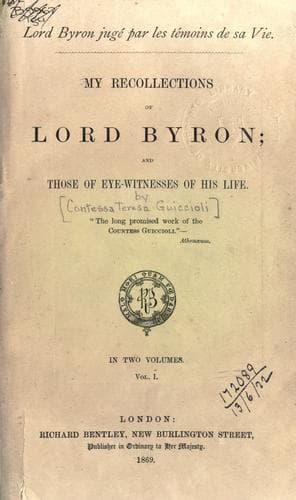
My Recollections of Lord ByronGuiccioli, Teresa, contessa di
General
My Recollections of Lord Byron
Guiccioli, Teresa, contessa di
Byron, George Gordon Byron, Baron, 1788-1824; Poets, English -- 19th century -- Biography
"But when, in the spring of 1823, a young man of amiable and engaging
manners, a M. St.----, brought direct from Genoa to Weimar, a few words
under the hand of this estimable friend, by way of recommendation, and
when, shortly after, there was spread a report that the noble lord was
about to consecrate his great powers and varied talents to high and
perilous enterprise, I had no longer a plea for delay, and addressed to
him the stanzas which ends by the lines,--'And he self-known, e'en as to
me he's known!'
"These verses," continued Goethe, "arrived at Genoa, but found him not.
This excellent friend had already sailed; but being driven back by
contrary winds, he landed at Leghorn, where this effusion of my heart
reached him. On the era of his departure, July 23, 1823, he found time
to send me a reply, full of the most beautiful ideas and the divinest
sentiments, which will be treasured as an invaluable testimony of worth
and friendship, among the choicest documents which I possess.
"What emotions of joy and hope did not that paper at once excite! but
now it has become, by the premature death of its noble writer, an
inestimable relic, and a source of unspeakable regret; for it
aggravates, to a peculiar degree in me, the mourning and melancholy that
pervade the whole moral and poetical world,--in me, who looked forward
(after the success of his great efforts) to the prospect of being
blessed with the sight of this master-spirit of the age--this friend so
fortunately acquired: and of having to welcome, on his return, the most
humane of conquerors."
These are, no doubt, most noble words, but they were called forth by the
still nobler conduct of Byron toward him. It can not be said that Goethe
ever appreciated all that there was of worth in his young rival, and a
few words at the end of his letter make one believe that he still
credited some of the absurd stories which he had been told about Byron's
youth, and whom he still believed to be identified in the person of
"Manfred." He entertained a great affection for Byron, no doubt, but he
believed, however, that indulgence and forgiveness were not only
necessary on his part, but actually generous in him.
Lord Byron's sympathetic admiration had this peculiarity,--that it did
not attach to one class of individuals devoted like himself to poetry,
but extended to every class of society. The statesman, the orator, the
philosopher, the prince, the subject, the learned, women, general, or
literary men, all were equally sure of having justice done to them. At
every page of his memoranda, we find instances of this. Thus of
Mackintosh he says: "He is a rare instance of the union of every
transcendent talent and great good-nature."
Of Curran he speaks in the most enthusiastic terms:--
Public-domain text, read in full here on John Shaqi.
Reviews
Reviews
No reviews yet
Be the first to share your thoughts on this work.
Elsewhere in the archive
Join the Discussion
Join the discussion
Sign in to leave a comment or review.
Sign InorCreate an account