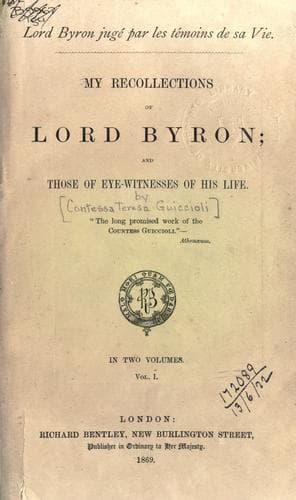
My Recollections of Lord ByronGuiccioli, Teresa, contessa di
General
My Recollections of Lord Byron
Guiccioli, Teresa, contessa di
Byron, George Gordon Byron, Baron, 1788-1824; Poets, English -- 19th century -- Biography
Such a calumny exasperated Byron's real friends, and among these Count
Gamba, who hastened to reply to it, by publishing an interesting book,
precious from its veracity, and which does equal credit to Byron and to
the young man honored with his friendship. After analyzing the
anonymous article, Count Gamba goes on to say: "My own opinion is just
the contrary to that of the writer in the magazine. I think he prided
himself on the successes of his friends, and cited them as a proof of
discernment in the choice of some of his companions. This I know, that
of envy he had not the least spark in his whole disposition: he had
strong antipathies, certainly, to one or two individuals; but I have
always understood, from those most likely to know, that he never broke
with any of the friends of his youth, and that his earliest attachments
were also his last."
It may be remarked that Byron's popularity made it difficult for him to
indulge sentiments of envy. But without referring to the unstable
character of popularity, was not his own attacked by the jealousy of
those who wished to pull him down from the pedestal of fame, to which
they hoped themselves to rise? Did he not think, some years before his
death, that his popularity was wavering, and that his rivals would
profit by it? Was he less pleased at the success of his friends? Does
not all he said, and all he did, prove that where he blamed he did so
unwillingly, from a sense of justice and truth; but that when he
praised, he did so to satisfy a desire of his heart?
We have dwelt at considerable length upon this subject, because we
believe that a total absence of envy is so rare among poets, and so
conspicuous in Lord Byron, that we can take it to be the criterion of
his nobility of soul. We can sum up, therefore, all we have said, by
declaring, that if Byron has been envied by all his enemies, and even
his friends, with, perhaps, the exception of Shelley, and has not
himself envied one, though he suffered personally from the consequences
of their jealousy, it is because the great kindness of his nature made
him the least envious of men.
FOOTNOTES:
[Footnote 28: Moore, Letter 261.]
[Footnote 29: Venice, 1817.]
[Footnote 30: Why has the passage in the first edition of Stendhall's
works, which treats in enthusiastic terms of Byron's genius, been cut
out of the subsequent editions?]
[Footnote 31: Was this a little irony? I think so, for it was believed
that jealousy was the weak point of Rogers.]
[Footnote 32: Moore, Letter 435.]
[Footnote 33: Moore, Letter 422.]
CHAPTER IX.
BENEVOLENCE AND KINDNESS OF LORD BYRON.
BENEVOLENCE.
Public-domain text, read in full here on John Shaqi.
Reviews
Reviews
No reviews yet
Be the first to share your thoughts on this work.
Elsewhere in the archive
Join the Discussion
Join the discussion
Sign in to leave a comment or review.
Sign InorCreate an account