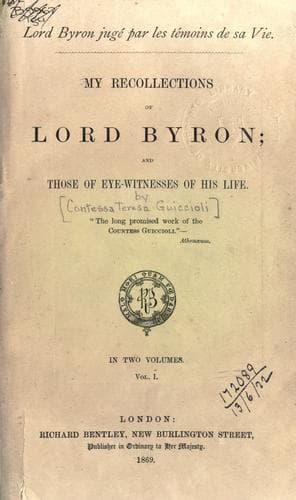
My Recollections of Lord ByronGuiccioli, Teresa, contessa di
General
My Recollections of Lord Byron
Guiccioli, Teresa, contessa di
Byron, George Gordon Byron, Baron, 1788-1824; Poets, English -- 19th century -- Biography
The benevolence of Byron's character constitutes the principal
characteristic of his nature, and was particularly remarkable from its
power. All the good qualities in Byron do not show the same force in the
same degree. In all the sentiments which we have analyzed and given in
proof of his goodness, though each may be very strong, and even capable
of inspiring him with the greatest sacrifice, yet one might find in each
that personal element, inherent in different degrees to our purest and
most generous affections, since the impulse which dictates them is
evidently based upon a desire to be satisfied with ourselves. The same
thing might be said of his benevolence, had it been only the result of
habit: but if it had been this, if it had been intermittent, and of that
kind which does not exclude occasional harshness and even cruelty, I
would not venture to present it to the reader as a proof of Byron's
goodness.
His benevolence had nothing personal in its elements. It was a kind of
universal and habitual charity, which gives without hope of return,
which is more occupied with the good of others than with its own, and
which is called for only by the instinctive desire to alleviate the
sufferings of others. If such a quality has no right to be called a
virtue, it nevertheless imprints upon the man who possesses it an
ineffaceable character of greatness.
There was not a single moment in his life in which it did not reveal
itself in the most touching actions. We have seen how neither happiness
nor misfortune could alter it.
As a child, he went one day to bathe with a little school-fellow in the
Don, in Scotland, and having but one very small Shetland pony between
them, each one walked and rode alternately. When they reached the
bridge, at a point where the river becomes sombre and romantic, Byron,
who was on foot, recollected a legendary prophecy, which says:--
"Brig o' Balgounie, black's your wa':
Wi' a wife's ae son and a mare's ae foal
Doun ye shall fa'!"
Little Byron stopped his companion, asked him if he remembered the
prediction, and declared that as the pony might very well be "a mare's
ae foal," he intended to cross first, for although both only sons, his
mother alone would mourn him, while the death of his friend, whose
father and mother were both alive, would cause a twofold grief.[34]
As a stripling, he saw at Southwell a poor woman sally mournfully from a
shop, because the Bible she wished to purchase costs more money than she
possesses. Byron hastens to buy it, and, full of joy, runs after the
poor creature to give it to her. As a young man, at an age when the
effervescence and giddiness of youth forget many things, he never forgot
that to seduce a young girl is a crime. Then, as ever, he was less the
seducer than the seduced.
Public-domain text, read in full here on John Shaqi.
Reviews
Reviews
No reviews yet
Be the first to share your thoughts on this work.
Elsewhere in the archive
Join the Discussion
Join the discussion
Sign in to leave a comment or review.
Sign InorCreate an account