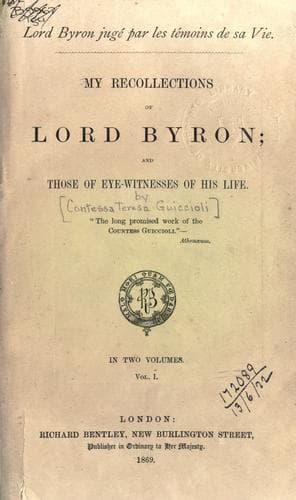
My Recollections of Lord ByronGuiccioli, Teresa, contessa di
General
My Recollections of Lord Byron
Guiccioli, Teresa, contessa di
Byron, George Gordon Byron, Baron, 1788-1824; Poets, English -- 19th century -- Biography
His hatred of contradiction and petty teasing, his repugnance to annoy
or mortify any one, arose from the same cause. Once, after having
replied with his usual frankness to an inquiry of Madame de Stael,
_that he thought a certain step ill-advised_, he wrote in his
memorandum-book:--"I have since reflected that it would be possible for
Mrs. B---- to be patroness; and I regret having given my opinion, as I
detest getting people into difficulties with themselves or their
favorites."
And again:--
"To-day C---- called, and, while sitting here, in came Merivale. During
our colloquy, C---- (ignorant that M----was the writer) abused the
mawkishness of the 'Quarterly Review,' on Grimm's correspondence. I
(knowing the secret) changed the conversation as soon as I could, and
C---- went away quite convinced of having made the most favorable
impression on his new acquaintance.... I did not look at him while this
was going on, but I felt like a coal; for I like Merivale, as well as
the article in question."
HIS INDULGENCE.
His indulgence, so great toward all, was excessive toward his inferiors.
"Lord Byron," says Medwin, "was the best of masters, and it may be
asserted that he was beloved by his servants; his goodness even extended
to their families. He liked them to have their children with them. I
remember, on one occasion, as we entered the hall, coming back from our
walk, we met the coachman's son, a boy of three or four years of age.
Byron took the child up in his arms and gave him ten pauls."
"His indulgence toward his servants," says Mr. Hoppner, "was almost
reprehensible, for even when they neglected their duty, he appeared
rather to laugh at than to scold them, and he never could make up his
mind to send them away, even after threatening to do so."
Mr. Hoppner quotes several instances of this indulgence, which he
frequently witnessed. I will relate one in which his kindness almost
amounts to virtue. On the point of leaving for Ravenna, whither his
heart passionately summoned him, Tita Falier, his gondolier, is taken
for the conscription. To release him it is not only necessary to pay
money, but also to take certain measures, and to delay his departure.
The money was given, and the much-desired journey postponed.
"The result was," says Hoppner, "that his servants were so attached to
him that they would have borne every thing for his sake. His death
plunged them into the deepest grief. I have in my possession a letter
written to his family by Byron's gondolier, Tita, who followed him from
Venice to Greece, and remained with him until his death. The poor fellow
speaks of his master in touching terms: he declares that in Byron he has
lost rather a father than a master, and he does not cease to dilate upon
the goodness with which Byron looked after the interests of all who
served him."
Fletcher also wrote to Murray after his master's death:--
Public-domain text, read in full here on John Shaqi.
Reviews
Reviews
No reviews yet
Be the first to share your thoughts on this work.
Elsewhere in the archive
Join the Discussion
Join the discussion
Sign in to leave a comment or review.
Sign InorCreate an account