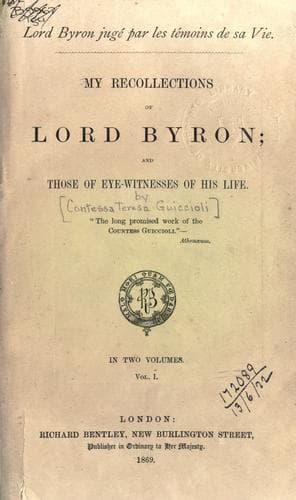
My Recollections of Lord ByronGuiccioli, Teresa, contessa di
General
My Recollections of Lord Byron
Guiccioli, Teresa, contessa di
Byron, George Gordon Byron, Baron, 1788-1824; Poets, English -- 19th century -- Biography
"And now, my dear Bankes, do not distress me by supposing that I can
think of you, or you of me, otherwise than I trust we have long thought.
You told me not long ago, that my temper was improved, and I should be
sorry that opinion should be revoked. Believe me, your friendship is of
more account to me than all those absurd vanities in which, I fear, you
conceive me to take too much interest. I have never disputed your
superiority, or doubted (seriously) your good-will, and no one shall
ever 'make mischief between us' without the sincere regret on the part
of your ever affectionate, etc.
"BYRON."
In the midst of the unexampled enthusiasm of a whole nation, Byron is
neither touched by the adoration which his genius inspires, nor the
endless praises which are bestowed upon him, nor the love declarations
which crowd his table, nor the flattering expressions of Lord Holland,
who ranks him next to Walter Scott as a poet, and to Burke as an orator;
nor indeed by those of Lord Fitzgerald, who, notwithstanding a flogging
at Harrow, can not bear malice against the author of "Childe Harold,"
but desires to forgive. To be the friend of those whom his satire
offended, so penetrates him with disgust for that poem, that his dearest
wish is to lose every trace of it; and, though the fifth edition is
nearly completed, he gives orders to his publisher, Cawthorn, to burn
the whole edition.
It is well known that on the occasion of the opening of the new Drury
Lane Theatre, the committee called upon all England's poetical talent
for an inaugural address. The committee received many, but found none
worthy of adoption. It was then that Lord Holland advised that Lord
Byron should be applied to, whose genius and popularity would enhance,
he said, the solemnity of the occasion. Lord Byron after a refusal, and
much hesitation arising partly from modesty and partly from the
knowledge that the rejected authors would make him pay a heavy price for
his triumph, at last, with much reluctance, accepted the invitation,
merely to oblige Lord Holland. He exchanged with the latter on this
topic a long correspondence, revealing so thoroughly his docility and
modesty, that Moore declares these letters valuable as an illustration
of his character; they show, in truth, the exceeding pliant good-nature
with which he listened to the counsel and criticism of his friends. "It
can not be questioned," says he, "that this docility, which he
invariably showed in matters upon which most authors are generally
tenacious and irritable, was a natural essence of his character, and
which might have been displayed on much more important occasions had he
been so fortunate as to become connected with people capable of
understanding and of guiding him."
Another time Moore wrote to him at Pisa:--"Knowing you as I do, Lady
Byron ought to have discovered, that you are the most docile and most
amiable man that ever existed, for those who live with you."
Public-domain text, read in full here on John Shaqi.
Reviews
Reviews
No reviews yet
Be the first to share your thoughts on this work.
Elsewhere in the archive
Join the Discussion
Join the discussion
Sign in to leave a comment or review.
Sign InorCreate an account