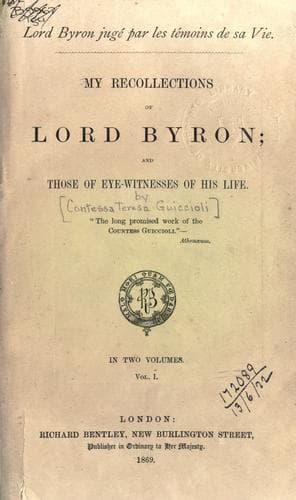
My Recollections of Lord ByronGuiccioli, Teresa, contessa di
General
My Recollections of Lord Byron
Guiccioli, Teresa, contessa di
Byron, George Gordon Byron, Baron, 1788-1824; Poets, English -- 19th century -- Biography
As to being himself a witness and spectator of scenes of violence, it
was an effort which exceeded the strength, however great, of his will.
Gifted with much psychological curiosity, and holding the theory that
every thing should be seen, he was present at Rome at the execution of
three murderers, who were to be put to death, on the eve of his
departure. This spectacle agitated him to such a degree that it brought
on a fever.
In Spain he attended a bull-fight. The painful impression produced by
the barbarous sight is immortalized in verse (_vide_ "Childe Harold,"
1st canto).
But his actions, above all, testify to his humane disposition. He never
heard of the misfortune or suffering of a fellow-creature without
endeavoring to relieve it, whether in London, Venice, Ravenna, Pisa, or
Greece; he spared neither gold, time, nor labor to achieve this object.
At Pisa, hearing that a wretched man, guilty of a sacrilegious theft,
was to be condemned to cruel torture, he became ill with dread and
anxiety. He wrote to the English ambassador, and to the consuls, begging
for their interposition; neglected no chance, and did not rest until he
acquired the certainty that the penalty inflicted on the culprit would
be more humane.
In Greece, where traits of generous compassion fill the rest of his
life, Count Gamba relates that Colonel Napier, then residing in the
Island of Cephalonia, one day rode in great haste to Lord Byron, to ask
for his assistance, a number of workmen, employed in making a road,
having been buried under the crumbling side of a mountain in consequence
of an imprudent operation. Lord Byron immediately dispatched his
physician, and, although just sitting down to table, had his horses
saddled, and galloped off to the scene of the disaster, accompanied by
Count Gamba and his suite. Women and children wept and moaned, the crowd
each moment increased, lamentations were heard on all sides, but,
whether from despair or laziness, none came forward. Generous anger
overcame Lord Byron at this scene of woe and shame; he leapt from his
horse, and, grasping the necessary implements, began with his own hands
the work of setting free the poor creatures, who were there buried
alive. His example aroused the courage of the others, and the
catastrophe was thus mitigated by the rescue of several victims. Count
Gamba, after dwelling on the good Lord Byron did everywhere, and on the
admirable life he led in Greece, expresses himself as follows in a
letter to Mr. Kennedy:--
Public-domain text, read in full here on John Shaqi.
Reviews
Reviews
No reviews yet
Be the first to share your thoughts on this work.
Elsewhere in the archive
Join the Discussion
Join the discussion
Sign in to leave a comment or review.
Sign InorCreate an account