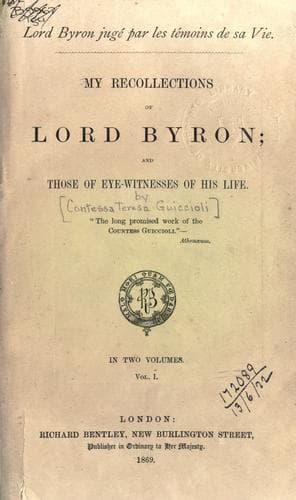
My Recollections of Lord ByronGuiccioli, Teresa, contessa di
General
My Recollections of Lord Byron
Guiccioli, Teresa, contessa di
Byron, George Gordon Byron, Baron, 1788-1824; Poets, English -- 19th century -- Biography
"One of his principal objects in Greece was to awaken the Turks as well
as the Greeks to more humane sentiments. You know how he hastened,
whenever the opportunity arose, to purchase the freedom of woman and
children, and to send them back to their homes. He frequently, and not
without incurring danger to himself, rescued Turks from the sanguinary
grasp of the Greek corsairs. When a Moslem brig drifted ashore near
Missolonghi, the Greeks wanted to capture the whole crew; but Lord Byron
opposed it, and promised a reward of a crown for each sailor, and of two
for each officer rescued."
"Coming to Greece," wrote Lord Byron, "one of my principal objects was
to alleviate, as much as possible, the miseries incident to a warfare so
cruel as the present. When the dictates of humanity are in question, I
know no difference between Turks and Greeks. It is enough that those who
want assistance are men, in order to claim the pity and protection of
the meanest pretender to humane feelings. I have found here twenty-four
Turks, including women and children, who have long pined in distress,
far from the means of support and the consolations of their home. The
Government has consigned them to me: I transmit them to Prevesa, whither
they desire to be sent. I hope you will not object to take care that
they may be restored to a place of safety, and that the governor of your
town may accept of my present. The best recompense I could hope for
would be to find that I had inspired the Ottoman commanders with the
same sentiments toward those unhappy Greeks, who may hereafter fall into
their hands.
"BYRON."
"Lord Byron," pursues Count Gamba, "never could witness a calamity as an
idle spectator. He was so alive to the sufferings of others, that he
sometimes allowed himself to be imposed upon too readily by tales of
woe. The least semblance of injustice excited his indignation, and led
him to intervene without a thought for the consequences to himself of
his interposition; and he entertained this feeling not only for his
fellow-creatures but even toward animals."
His compassion extended to every living creature, to every thing that
could feel. Without alluding to his well-known fondness for dogs, and
for the animals of every kind he liked to have about him, and of which
he took the greatest care, it will be sufficient to point out the motive
which led him to deprive himself of the pleasures of the chase,--a
pastime that would have been, from his keen enjoyment of bodily
exercises, so congenial to his tastes. The reason is found in his
memorandum for 1814:--
"The last bird I ever fired at was an eaglet, on the shore of the Gulf
of Lepanto, near Vostitza. It was only wounded, and I tried to save it,
the eye was so bright: but it pined and died in a few days; and I never
did since, and never will, attempt the death of another bird."
Angling, as well as shooting, he considered cruel.
Public-domain text, read in full here on John Shaqi.
Reviews
Reviews
No reviews yet
Be the first to share your thoughts on this work.
Elsewhere in the archive
Join the Discussion
Join the discussion
Sign in to leave a comment or review.
Sign InorCreate an account