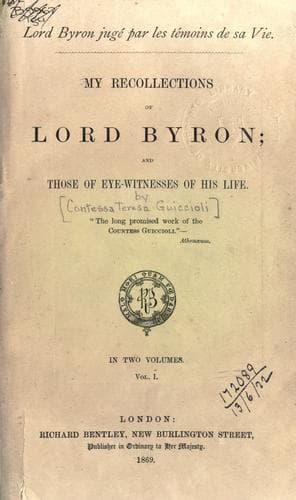
My Recollections of Lord ByronGuiccioli, Teresa, contessa di
General
My Recollections of Lord Byron
Guiccioli, Teresa, contessa di
Byron, George Gordon Byron, Baron, 1788-1824; Poets, English -- 19th century -- Biography
"SIR,--I leave town for a few days to-morrow; on my return I will
answer your letter more at length. Whatever may be your situation,
I can not but commend your resolution to abjure and abandon the
publication and composition of works such as those to which you
have alluded. Depend upon it they amuse few, disgrace both reader
and writer, and benefit none. It will be my wish to assist you, as
far as my limited means will admit, to break such a bondage. In
your answer inform me what sum you think would enable you to
extricate yourself from the hands of your employers, and to regain,
at least, temporary independence, and I shall be glad to contribute
my mite toward it. At present, I must conclude. Your name is not
unknown to me, and I regret, for my own sake, that you have ever
lent it to the works you mention. In saying this, I merely repeat
your own words in your letter to me, and have no wish whatever to
say a single syllable that may appear to insult your misfortunes.
If I have, excuse me: it is unintentional.
BYRON."
Mr. Ashe replied with a request for a sum of about four thousand francs.
Lord Byron having somewhat delayed answering him, Ashe reiterated his
request, complaining of the procrastination; whereupon, "with a kindness
which few," says Moore, "would imitate in a similar case," Byron wrote
to him as follows:--
"SIR,--When you accuse a stranger of neglect, you forget that it is
possible business or absence from London may have interfered to
delay his answer, as has actually occurred in the present instance.
But to the point. I am willing to do what I can to extricate you
from your situation.... I will deposit in Mr. Murray's hands (with
his consent) the sum you mentioned, to be advanced for the time at
ten pounds per month.
"P.S.--I write in the greatest hurry, which may make my letter a
little abrupt; but, as I said before, I have no wish to distress
your feelings.
BYRON."
Ashe, a few months later, asked for the whole amount, to defray his
travelling expenses to New South Wales, and Lord Byron again remitted to
him the entire amount.
On another occasion, some unhappy person being discussed in harsh terms,
the remark was made that he deserved his misery. Lord Byron turned on
the accuser, and fired with generous anger, "Well!" exclaimed he, "if it
be true that N---- is unfortunate, and that he be so through his own
fault, he is doubly to be pitied, because his conscience must poison his
grief with remorse. Such are my morals, and that is why I pity error and
respect misfortune."
Public-domain text, read in full here on John Shaqi.
Reviews
Reviews
No reviews yet
Be the first to share your thoughts on this work.
Elsewhere in the archive
Join the Discussion
Join the discussion
Sign in to leave a comment or review.
Sign InorCreate an account