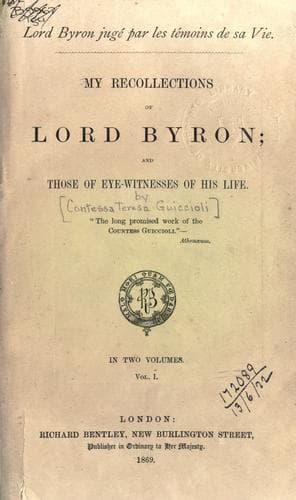
My Recollections of Lord ByronGuiccioli, Teresa, contessa di
General
My Recollections of Lord Byron
Guiccioli, Teresa, contessa di
Byron, George Gordon Byron, Baron, 1788-1824; Poets, English -- 19th century -- Biography
Although, in thus analyzing and enumerating the proofs of his innate
goodness, we have declared we did not entertain the pretension of
elevating them to the rank of lofty virtues, we are yet compelled to
state that if his generosity was too instinctive to be termed a virtue,
it was yet too admirable to be considered as an instinct; that while in
remaining a quality of his heart, it elevated and transformed itself
often through the exertion of his will into an absolute virtue, and
through all its phases and in its double nature, it presented in Lord
Byron a remarkably rare blending of all that is most lovable and
estimable in the human soul.
Here we merely speak of the generosity that showed itself in benefits
conferred. As to that which consists rather in self-denial, sacrifice
which forgives injuries, and which is the greatest triumph of mortal
courage, that, in a word, is indeed a sublime virtue. Such generosity,
if he possessed it, we will treat of in another chapter.[35]
As we here wish to establish by facts that only which appears to have
been the impulse of his good heart, the difficulty lies in the choice of
proofs, and in the necessity of limiting our narrative. We will,
therefore, in order not to convert this chapter into a volume, forbear
from quoting more than a few instances; but justice requires us to say,
that misfortune or poverty never had recourse to him in vain; that
neither the pecuniary embarrassments of his youth, nor the slender
merits of the applicants, nor any of the pretexts so convenient to weak
or hypocritical[36] liberality, ever could become a reason with him to
refuse those who stretched out their hand to him. The claim of
adversity, as adversity, was a sufficient and sacred one to him, and to
relieve it an imperious impulse.
An appeal was once made to Lord Byron's generosity by an individual
whose bad repute alone might have justified a harsh rebuff. But Lord
Byron, whose charity was of a higher order, looked upon it otherwise.
"Why," said Murray, "should you give L150 to this bad writer, to whom
nobody would give a penny?" "Precisely because nobody is willing to give
him any thing is he the more in need that I should help him," answered
Lord Byron.
A certain Mr. Ashe superintended the publication of a paper called "The
Book," the readers of which were attracted rather by its ill-nature and
scandal, and the revelations it made in lifting the veil that had so far
concealed the most delicate mysteries, than by the talent of the author.
In a fit of repentance this man wrote to Lord Byron, alleging his great
poverty as an apology for having thus prostituted his pen, and imploring
from Lord Byron a gift to enable him to live more honorably in future.
Lord Byron's answer to this letter is so remarkable for its good sense,
kindness, and high tone of honor, that we can not refrain from
reproducing it.
Public-domain text, read in full here on John Shaqi.
Reviews
Reviews
No reviews yet
Be the first to share your thoughts on this work.
Elsewhere in the archive
Join the Discussion
Join the discussion
Sign in to leave a comment or review.
Sign InorCreate an account