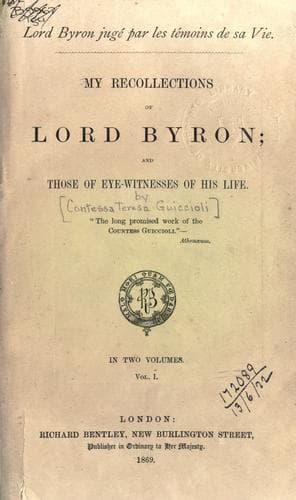
My Recollections of Lord ByronGuiccioli, Teresa, contessa di
General
My Recollections of Lord Byron
Guiccioli, Teresa, contessa di
Byron, George Gordon Byron, Baron, 1788-1824; Poets, English -- 19th century -- Biography
"What a great crime death has committed! It is something like the
disappearance of a star, or the extinction of a planet, with all the
creation it supposed. When great minds have accomplished their task,
like Shakspeare, Dante, Goethe, their departure from the scene of the
world leaves in the soul the sublime melancholy which presides over the
setting of the sun, after it has poured out all its rays. But when we
hear of the death of a Raphael, of a Mozart, and especially of Byron,
struck down in their flight, just at the time when they were extending
their course, we can not refrain from calling these an eternal cause for
mourning, irreparable losses, and inconsolable regrets! A genius who
dies prematurely carries treasures away with him! How many ideal
existences were linked with his own! What sublime thoughts vanish from
his brow! What great and charming characters die with him, even before
they are born! How many truths postponed, at least, for humanity!"
And we will add: to how many great and noble actions his death has put
an end!
Such regrets do honor as much to those who experience them as to those
who give them rise. But it is not to the enthusiasm created by his
genius, nor to the grief evinced by the Greek nation, for whom he died,
that we will turn for a last proof of the goodness of his nature. Such
regrets might almost be called interested,--emanating, as they do, from
the knowledge of the loss of a treasure. Of the tears of the heart,
which were shed for the man without his genius, shall we ask that last
proof.
These are the words by which Count Gamba describes his affliction:--
"In vain should I attempt to describe the deep, the distressing sorrow
that overwhelmed us all. I will not speak of myself, but of those who
loved him less, because they had seen him less. Not only Mavrocordato
and his immediate circle, but the whole city and all its inhabitants
were, as it seemed, stunned by the blow--it had been so sudden, so
unexpected. His illness, indeed, had been known; and for the three last
days, none of us could walk in the streets, without anxious inquiries
from every one who met us, of 'How is my lord?' We did not mourn the
loss of the great genius,--no, nor that of the supporter of Greece--our
first tears were for our father, our patron, our friend. He died in a
strange land, and among strangers: but more loved, more sincerely wept,
he could never have been, wherever he had breathed his last.
"Such was the attachment, mingled with a sort of reverence and
enthusiasm, with which he inspired those around him, that there was not
one of us who would not, for his sake, have willingly encountered any
danger in the world. The Greeks of every class and every age, from
Mavrocordato to the meanest citizen, sympathized with our sorrows. It
was in vain that, when we met, we tried to keep up our spirits--our
attempts at consolation always ended in mutual tears."
Public-domain text, read in full here on John Shaqi.
Reviews
Reviews
No reviews yet
Be the first to share your thoughts on this work.
Elsewhere in the archive
Join the Discussion
Join the discussion
Sign in to leave a comment or review.
Sign InorCreate an account