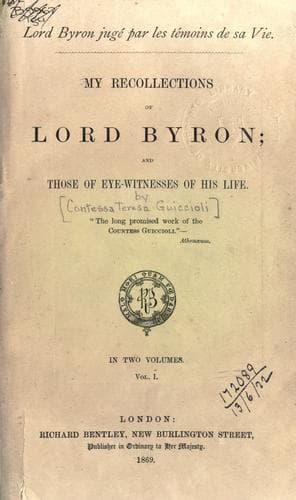
My Recollections of Lord ByronGuiccioli, Teresa, contessa di
General
My Recollections of Lord Byron
Guiccioli, Teresa, contessa di
Byron, George Gordon Byron, Baron, 1788-1824; Poets, English -- 19th century -- Biography
None but beautiful souls, and those who are really thoroughly good, can
be thus regretted; and heartfelt tears are only shed for those who have
spent their life in drying those of others.
FOOTNOTES:
[Footnote 34: Galt's Life of Byron, p. 329.]
[Footnote 35: See chapter "Generosity raised to a Virtue."]
[Footnote 36: When travelling in Greece, he often found himself in
straitened circumstances, merely because he had helped a friend.
"It is probable," he wrote to his mother from Athens in 1811, "I may
steer homeward in spring: but, to enable me to do that, I must have
remittances. My own funds would have lasted me very well: but I was
obliged to assist a friend, who I know will pay me, but in the mean time
I am out of pocket."]
[Footnote 37: It may be observed here, that he was not willing, even to
confide to paper, the nature and degree of the act of kindness. Hodgson
wanted thirty-five thousand francs to establish himself. Byron actually
borrowed this amount, to give it to him, as he had not the sum at his
disposal.]
[Footnote 38: See his "Life in Italy."]
[Footnote 39: Vide Kennedy.]
[Footnote 40: "Yesterday I paid him (to Scroope Davies) four thousand
eight hundred pounds, ... and my mind is much relieved by the removal of
that debt," he says in his memorandum of 1813. All his difficulties were
inherited from his father, and not contracted by him personally.]
[Footnote 41: Although not rich, and on the point of undertaking a long
and expensive journey, he devoted a large sum to the alleviation of the
wants of that family.]
CHAPTER X.
QUALITIES AND VIRTUES OF SOUL.
ANTIMATERIALISM.
Among Lord Byron's natural qualities we may rank his antipathy, not only
for any thing like low sensuality or gross vice, but even for those
follies to which youth and human nature are so prone. Whatever may have
been said on this head, and notwithstanding the countenance Lord Byron's
own words may have lent to calumnies too widely believed, it will be
easy to prove the truth of our assertion. Let us examine his actions,
his words (when serious), the testimony of those who knew him through
life, and it will soon appear that this natural antipathy with him often
attained to the height of rare virtue.
Lord Byron had a passionate nature, a feeling heart, a powerful
imagination; and it can not be denied that, after the disappointment he
experienced in his ethereal love entertained at fifteen, he fell into
the usual round of university life. But as he possessed great refinement
of mind, never losing sight of an ideal of moral beauty, such an
existence speedily became odious to him. His companions thought it all
quite natural and pleasant; but he disapproved of it and blamed himself,
feeling ashamed in his own conscience.
It is well known that Lord Byron never spared himself. He invented
faults rather than sought to extenuate them. And so he fully merits
belief, when he happens to do himself justice. Let us attend to the
following:--
Public-domain text, read in full here on John Shaqi.
Reviews
Reviews
No reviews yet
Be the first to share your thoughts on this work.
Elsewhere in the archive
Join the Discussion
Join the discussion
Sign in to leave a comment or review.
Sign InorCreate an account